.png)

Let’s build something great
See how Totally’s API can support your reward and payout workflows. Talk to our team to explore your use case, or access our documentation when you’re ready to get started.
Book a Demo
Most marketing teams measure reward campaigns the same way they measure paid media. This piece breaks down the metrics that actually capture what incentive programmes deliver, the benchmarks that give those metrics context, and how to build an ROI model your finance team will take seriously.

.png)
If you're running reward or incentive campaigns, you already know they work. You've seen the engagement spike when a well-timed gift card lands in someone's inbox. You've watched referral numbers climb when the incentive is right. However, is your measurement framework really doing your campaign justice, validating the tangible results you're actually delivering?
Most marketing teams measure reward campaigns the same way they measure paid media. Click-through rates. Cost per lead. Conversion within a seven-day window. This isn’t necessarily incorrect, however these metrics only tell a portion of the story. Reward campaigns operate differently from paid media campaigns. Paid media buys you a moment of attention and possible engagement. A reward campaign creates a moment of connection between your brand and the recipient. It's a branded experience that builds trust, generates goodwill, and influences behaviour well beyond the initial interaction.
When you measure rewards through the same lens as your Google Ads campaign, you often end up undervaluing what's working and missing the key signals crucial for optimisation.
This piece is designed to help you fix that. We'll walk through the metrics that genuinely matter for reward campaign performance, share the benchmarks that give those metrics context, and show you how to build an ROI model that your finance team will actually believe.
There's a reason reward-driven marketing is growing so fast. Customer acquisition costs have risen 40 to 60 percent since 2023 across most digital channels. B2B paid search now sits at around £630 per customer acquired, and LinkedIn campaigns run closer to £770. Meanwhile, well-run referral and incentive programmes are acquiring customers at a fraction of that cost, typically between £110 and £160 for B2B SaaS companies.
Beyond lower CAC, reward campaigns deliver significant downstream benefits. Customers acquired through referral and incentive programmes convert at three to five times the rate of leads from paid channels. They show 16 to 25 percent higher lifetime value. They churn less. And loyalty programme members generate 12 to 18 percent more incremental revenue growth per year than non-members.
The challenge is that standard campaign metrics weren't designed for this. They were built to evaluate attention-based marketing, where the value is front-loaded and the attribution window is short. Rewards work on a longer arc. The value builds through the experience of receiving, choosing, and redeeming something personal. It deepens through the goodwill that follows. And it compounds through repeat purchases and referrals that can stretch months beyond the initial campaign.
So what should you actually be tracking?
This is the metric that helps you make the business case internally for more budget allocation.
The calculation itself is straightforward. Take the total cost of your reward programme (reward face value, delivery and platform costs, internal time to manage it, any promotional spend) and divide by the number of new customers acquired through the programme. Then set that number alongside your blended CAC across other channels.
The gap is usually wider than people expect. As mentioned earlier, referral-driven CAC typically runs between £110 and £160, while paid channels sit considerably higher. But the comparison goes beyond initial acquisition cost alone. When you factor in that reward-acquired customers tend to have higher lifetime value, better retention, and stronger referral behaviour, the effective return on a reward programme looks very different to its face-value cost.
Successful referral and incentive programmes typically deliver 3:1 to 5:1 ROI, with top-performing programmes reaching significantly higher. Loyalty programme managers report an average return of 4.8 times their investment.
If you're not running this comparison at least quarterly, there's a good chance you're over-allocating budget to channels that look efficient at a click level but underperform on a retained-customer level.
For B2B marketing teams, proving the link between marketing touchpoints and pipeline progression is a top priority. This looks beyond just direct attribution and helps you understand how those reward campaigns are directly impacting the progress of your sales pipeline.
Did the prospect come to your hosted event because of the incentive? Did a referral reward bring in a warm introduction that moved a deal forward? Did a milestone reward during onboarding reduce early-stage churn?
If your CRM tracks touchpoints, tag reward interactions as a distinct channel and start measuring influenced pipeline. That means total opportunity value where a reward touchpoint occurred at any stage of the deal, not just first or last source before close.
Companies with mature loyalty and reward programmes report that they contribute between 10 and 30 percent of new customer revenue when fully optimised. These are numbers you can take to your CFO to justify that increase to your marketing budget during the annual review.
One of the biggest missed opportunities in reward marketing is structured experimentation. Most teams choose a reward type and value based on instinct and run with it. They rarely test whether a different combination would perform better. Here's a framework that goes beyond basic A/B splits.
What's worth testing. Reward value is an obvious starting point. Does a £10 coffee voucher outperform a £25 multi-choice reward? The answer often surprises people. Higher monetary value doesn't always win. The perceived thoughtfulness and brand alignment of the reward can matter just as much as the denomination. Recipients also tend to spend well above the card value at checkout (the average overspend sits around £32), so the downstream revenue impact often dwarfs the cost difference between reward tiers.
Reward type is another valuable variable. Single-brand gift cards, multi-choice reward, and prepaid cards each attract different behaviour. Multi-choice rewards tend to drive higher redemption because people feel a sense of ownership when they pick their own reward. Prepaid cards offer maximum flexibility but create less brand connection.
Personalisation depth is often the highest-leverage test of all. A generic reward versus a personalised selection versus a fully branded experience (with tailored messaging, curated options, and the recipient's name) can show dramatically different engagement. Research shows 56 percent of consumers say they'll become repeat buyers after a personalised experience, and 80 percent of businesses report that consumers spend more when the experience is personalised. The incremental cost of adding that personal touch is usually small relative to the uplift it creates.
How to structure tests. Run each variation with a minimum sample of 500 per group. Hold everything else constant. And measure across the full funnel, not just initial conversion, but redemption rate, time-to-redemption, repeat engagement, and 90-day retention. A variant that shows slightly lower initial conversion but meaningfully higher redemption and retention is almost always the better long-term bet.
Tackling incrementality. The trickiest question in any reward programme is: would this customer have converted anyway? The cleanest way to answer it is a holdout test. Run a control group that receives no reward while the test group does, keeping every other campaign element identical. Compare conversion rates, retention, and lifetime value over a 90-day window minimum.
When a true holdout isn't practical (which is often the case in retention programmes, where withholding rewards from loyal customers creates its own issues), a matched cohort analysis works well. Compare rewarded customers against a statistically similar group from a period before the programme launched, adjusting for seasonality and other variables.
Here's how to build a credible ROI model using your own numbers.
Start by gathering your inputs: your current blended CAC across all channels, your average customer lifetime value, and the full costs of your reward programme (including reward value, delivery, platform costs, and internal time).
Then track your outputs: the number of new customers acquired through the programme, your redemption rate, the average order value of reward-acquired customers compared to your baseline, the 90-day retention rate for those customers, and whether they refer others at a higher rate than customers from other channels.
The formula is straightforward. ROI equals incremental revenue attributable to the programme, minus total programme cost, divided by total programme cost, multiplied by 100.
The word that matters most here is incremental. If your programme acquires 200 new customers but your holdout analysis suggests 60 of them would have converted through existing channels, your true incremental acquisition is 140. Build your ROI on the honest number and it'll hold up to scrutiny.
In terms of what realistic early-stage returns look like, well-run programmes typically deliver 3:1 to 5:1 ROI in their first year, scaling higher as the programme matures and referral loops start to compound. The key driver of improvement over time is getting better at matching the right reward to the right person at the right moment.
Everything in this piece comes back to one idea: the value of reward campaigns is significant, but only visible when you have the right infrastructure to track, measure, and optimise.
That's what Totally is built for. We're a digital rewards and payouts platform designed for marketing, growth, and operations teams who want to run incentive campaigns at scale without drowning in admin.
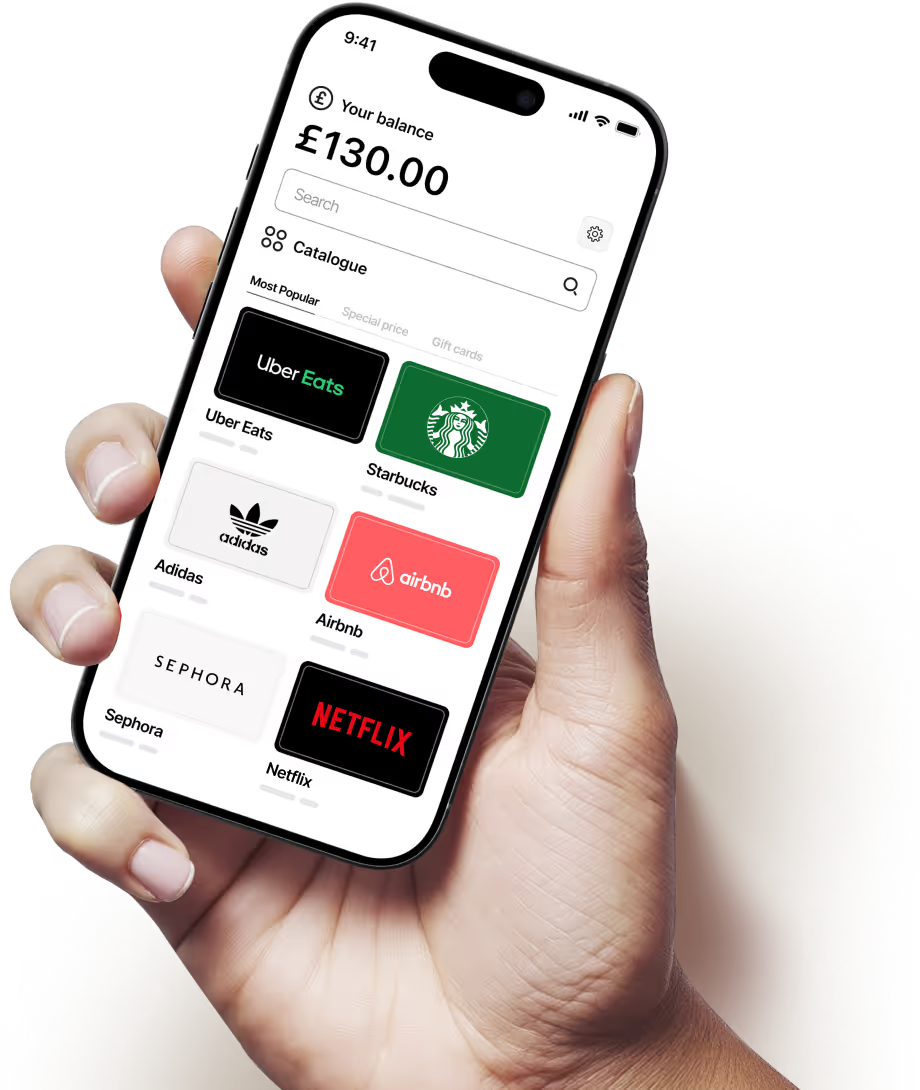
Practically, that means access to over 3,000 digital gift card brands across 50+ countries, prepaid Visa and Mastercard options, and multi-choice reward gift card where recipients pick their own reward. Every campaign is customisable down to the branding, messaging, and reward selection, so the moment someone receives a reward, it feels like it came from you, not from a faceless platform.
Additionally, Totally's API integrates directly into your existing CRM and marketing workflows, allowing you to automate reward triggers, tag touchpoints for attribution, and run structured A/B tests at a scale that would be impossible to manage manually.
If you're currently running reward or incentive campaigns and measuring them like any other channel, three steps will move you forward quickly.
First, audit what you're tracking. Map your current metrics against the framework in this piece and identify the gaps. Chances are, redemption rate, time-to-redemption, and reward-influenced pipeline are missing from your dashboards.
Second, run the CAC comparison. Calculate your reward-driven acquisition cost and set it against your blended CAC across paid, organic, and outbound channels. This single comparison often reveals that rewards are delivering more value per pound than anything else in the mix.
Third, design one structured test for your next campaign. Pick a single variable (reward type, value, or personalisation level), run it with a proper control group, and measure the full funnel through to 90-day retention. The insights from that one test will shape everything you do next.
Rewards are one of the few marketing investments where returns get better over time rather than diminishing. You just need to measure them in a way that reflects the customer lifetime value they deliver.
Ready to see what measurable, personalised reward campaigns look like in practice? Get in touch.
.avif)