.png)

Let’s build something great
See how Totally’s API can support your reward and payout workflows. Talk to our team to explore your use case, or access our documentation when you’re ready to get started.
Book a Demo
Giving people a choice of reward is a good start. Shaping the entire experience around what you know about them is where the real value sits. We break down how first-party data, AI, and modern platform infrastructure can help you personalise rewards at scale.


As humans we like to have options to choose from. When someone can pick a brand they love as a reward option over one they'd never use, the experience improves and redemption rates go up. Multi-choice rewards, prepaid cards, curated catalogues: these solve the fundamental problem of sending someone something they don't want.
But choice is only one layer of personalisation. The wrapping around the reward matters just as much as what's inside it. How the email is worded. Whether the landing page feels like it was designed for the recipient or assembled from a template. Whether the timing catches someone at a moment when a reward feels like a genuine acknowledgement rather than an automated trigger. Whether the experience carries your brand or feels like it came from a generic platform.
71% of customers now expect interactions that feel personally relevant, and 76% get frustrated when they don't. Those expectations aren't just about product recommendations or targeted ads. They extend to every touchpoint, including the moments when a company says thank you, congratulations, or here's something for your time.
This piece looks at how to build that added layer of personalisation into your rewards programme, using first-party data, AI, and modern platform infrastructure, without losing the human touch that makes a reward feel like it actually means something.
These two ideas are often treated as interchangeable, but they serve different purposes and they're most powerful in combination.
Choice gives recipients agency. A multi-choice reward where someone picks from a curated selection of brands creates a sense of ownership. Prepaid cards offer maximum flexibility. Both formats drive strong redemption because the recipient ends up with something they genuinely want. That matters, and any personalisation strategy should preserve it.
Personalisation is what happens around that choice. It's the curation that determines which gift card brands appear first based on what you know about the recipient. It's the branded experience that makes the reward feel like a considered gesture from your company rather than a transaction from a platform. It's the message that references a specific milestone, behaviour, or moment rather than defaulting to generic copy. And it's the timing that puts the reward in front of someone when they're most likely to engage with it.
When you combine strong choice architecture with thoughtful personalisation, you get the best of both: recipients feel in control of what they receive while also feeling that the company behind the reward actually thought about them as an individual. 84% of consumers say they're more likely to buy from brands that treat them as people rather than segments, and personalised loyalty messaging drives 20 to 40% higher repeat purchase rates. The compounding effect of choice plus personalisation is where the real value sits.
The shift towards first-party data collection is often framed as a privacy compliance story, and it is that. But for rewards programmes specifically, it also opens up personalisation possibilities that simply weren't available when everyone was working with third-party cookies and broad demographic segments.
First-party data is information you collect directly through your own interactions: transaction history, engagement behaviour, stated preferences, survey responses, past redemption patterns. It tends to be more accurate and more actionable than anything sourced externally, because it reflects what people have actually done rather than what a model predicts they might do. 61% of high-growth companies have already shifted towards first-party data as the backbone of their personalisation strategy.
In the context of rewards and incentives, this data enables several layers of personalisation that go well beyond selecting which brands to include in a catalogue.
Reward-type preferences. If someone consistently redeems food and drink gift cards over retail or entertainment options, that pattern is a clear signal. Surfacing restaurant and café brands first in their reward experience isn't intrusive. It shows you've been paying attention to what they value, and it makes the selection process faster and more enjoyable for them.
Timing and context. When do your recipients tend to open and redeem rewards? How quickly after receiving a reward do they engage? If a particular segment engages with reward emails on Friday evenings, sending at 9am on Tuesday means the email is buried by the time they're ready to look at it. In rewards, timing is part of the experience, not just a deliverability variable.
Value calibration. Different segments respond differently to different reward values, and the relationship between face value and engagement isn't always linear. Some audiences convert better with a £10 coffee voucher than a £25 multi-choice reward, because the specificity of the smaller reward signals more thought than the generosity of the larger one. First-party data lets you test these dynamics and respond to what your audience actually values rather than what seems logical on paper.
Geographic and cultural relevance. A reward experience that resonates in London might feel completely off in Dubai, Tokyo, or São Paulo. Brand preferences, appropriate values, visual design expectations, and even the tone of the messaging vary significantly across markets. First-party data combined with local knowledge allows you to adjust the entire experience, not just the available brands, to reflect what feels natural and appropriate in each market.
First-party data provides the raw material. AI is what allows you to act on it across thousands of recipients without building individual campaigns for each one.
The conversation around AI and personalisation can get abstract, so here's what it concretely enables in rewards and incentive programmes.
Segmentation that updates itself. Traditional segmentation assigns people to groups based on attributes captured at a point in time and leaves them there until someone manually revisits the model. AI-driven segmentation evolves continuously as behaviour changes. A customer who was highly engaged last quarter but has gone quiet for six weeks gets reclassified automatically, and the reward approach adjusts with them. 92% of businesses now report using AI-driven personalisation, and 96% say it has improved their personalisation ROI.
Smarter reward surfacing. Rather than presenting every recipient with the same set of options in the same order, AI can rank and prioritise reward selections based on what similar recipients have chosen and redeemed previously. This is the same logic behind product recommendation engines (a market projected to grow from $8.2 billion to over $82 billion by 2034) applied to the reward selection experience. The recipient still chooses, but the options they see first are more likely to be options they'll value.
Timing that adapts to behaviour. AI can analyse redemption patterns across your recipient base and identify the windows where engagement is most likely for different segments, days, and contexts. Personalised notifications driven by timing optimisation increase engagement by 30 to 60% depending on segmentation quality. The same principle applies directly to reward delivery.
Continuous learning without manual intervention. Instead of running periodic A/B tests, waiting for results, and then manually adjusting the next campaign, AI enables ongoing experimentation across reward types, values, messaging, and timing. It learns from each interaction and applies those learnings to the next one without someone needing to pull a report and make a call.
One important caveat: AI is very good at identifying patterns and optimising for measurable outcomes, but it's less equipped to judge whether a particular reward feels right for a particular moment. That sense of appropriateness, of what will land as thoughtful rather than algorithmic, still requires people who understand the audience, the context, and the brand. The most effective approach treats AI as a tool that makes good judgment scalable, not as a replacement for judgment itself.
Any approach to personalisation that relies on data has to account for how that data is collected, stored, and used. In 2026, this is a strategic consideration, not just a legal checkbox.
The numbers tell an interesting story. 82% of consumers say they're willing to share personal data in exchange for a more customised experience. But 93% say they would lose trust in a brand entirely if that data were mishandled. People want personalisation. They also want to know that the data making it possible is being treated with care.
For rewards programmes, a few principles help navigate this well.
Make the value exchange visible. When you ask someone to share preferences or provide information, connect it directly to what they'll get in return. "Tell us what you're into so we can send you rewards you'll actually want" is a clear, fair exchange. Collecting behavioural data silently and then surfacing a suspiciously accurate recommendation without context risks feeling more surveillance than service, even if the intent is good.
Let people control what they share. Active consent improves both compliance and data quality. When someone deliberately tells you they prefer dining experiences over retail shopping, that signal is far more reliable than an inference drawn from browsing behaviour. Preference centres, onboarding questions, and redemption feedback loops all create opportunities to gather consented data that directly improves the reward experience.
Use existing data better before collecting more. Most programmes are sitting on redemption data, engagement patterns, and preference signals they've never fully activated. Improving data hygiene and actually using what you have frequently unlocks 10 to 25% incremental performance gains. You may not need more data. You may just need to use what you already have more thoughtfully.
The programmes that handle privacy well tend to see it as a relationship-building tool rather than a constraint. When personalisation is built on data people knowingly shared, the experience feels collaborative. When it's built on data people didn't realise they were giving away, even good personalisation can create discomfort.
Personalising rewards at scale introduces complexities, however planning for them is much easier than discovering them mid-programme.
Personalisation that feels too precise. There's a line between helpful and unsettling, and 28% of consumers say they actively dislike receiving recommendations based on information they didn't explicitly share. The safest approach is to personalise based on data the recipient knows you have (their redemption history, their stated preferences, their location) and be transparent about how it informs the experience. When in doubt, a slightly less targeted experience that feels respectful will always outperform a highly targeted one that feels invasive.
Cultural and geographic complexity. A personalisation framework designed for one market won't automatically translate to another. Gift-giving norms, appropriate reward values, brand preferences, communication styles, and even visual design expectations vary meaningfully across cultures. Running a global rewards programme means building localisation into the personalisation strategy from the start, not bolting it on after the fact. This goes beyond translating copy and converting currency. It means understanding what a thoughtful gesture looks like in each market you operate in.
The gap between strategy and execution. 96% of retailers report struggling with personalisation execution, and the barriers are typically operational rather than strategic. Data sits in silos. Platforms don't integrate cleanly. Marketing and operations aren't aligned on what personalisation means in practice. The most effective starting point is usually narrow and specific: pick one or two personalisation variables, test them on a single campaign, measure the results, and expand from there. Trying to personalise everything at once is how programmes stall before they launch.
If your rewards programme currently offers strong choice but limited personalisation around that choice, a few focused steps will create meaningful progress.
Audit what you already know. Look at your existing redemption data, engagement patterns, and any preference information you've collected. Map out what you know about your recipients and identify how much of that knowledge currently influences the reward experience. For most businesses, the answer reveals a significant gap between available data and how it's being used.
Test one personalisation variable on your next campaign. Curate reward selections by segment. Adjust delivery timing based on engagement patterns. Personalise the landing page messaging to reference the recipient's specific milestone or achievement. Pick one, run it against a control group, and measure redemption rate, time-to-redemption, and 90-day downstream behaviour. That single test will generate more actionable insight than months of planning.
Build the feedback loop. Every reward you send generates data about what resonated and what didn't. Making sure that data feeds back into your next campaign creates a compounding effect where each programme performs better than the last. The brands seeing the strongest returns from personalisation aren't the ones with the most sophisticated technology. They're the ones running this loop consistently.
Invest in the right infrastructure. Personalisation at scale requires a platform that supports dynamic reward curation, localised delivery, branded recipient experiences, and real-time performance tracking without creating manual work for every campaign. The gap between personalisation as a strategic advantage and personalisation as an operational burden usually comes down to whether the technology handles the complexity or whether your team is absorbing it.
Totally is designed to make personalised reward experiences practical at scale. The platform gives marketing, loyalty, and operations teams the infrastructure to deliver individually relevant rewards across 50+ countries without the operational complexity that typically makes personalisation unsustainable.
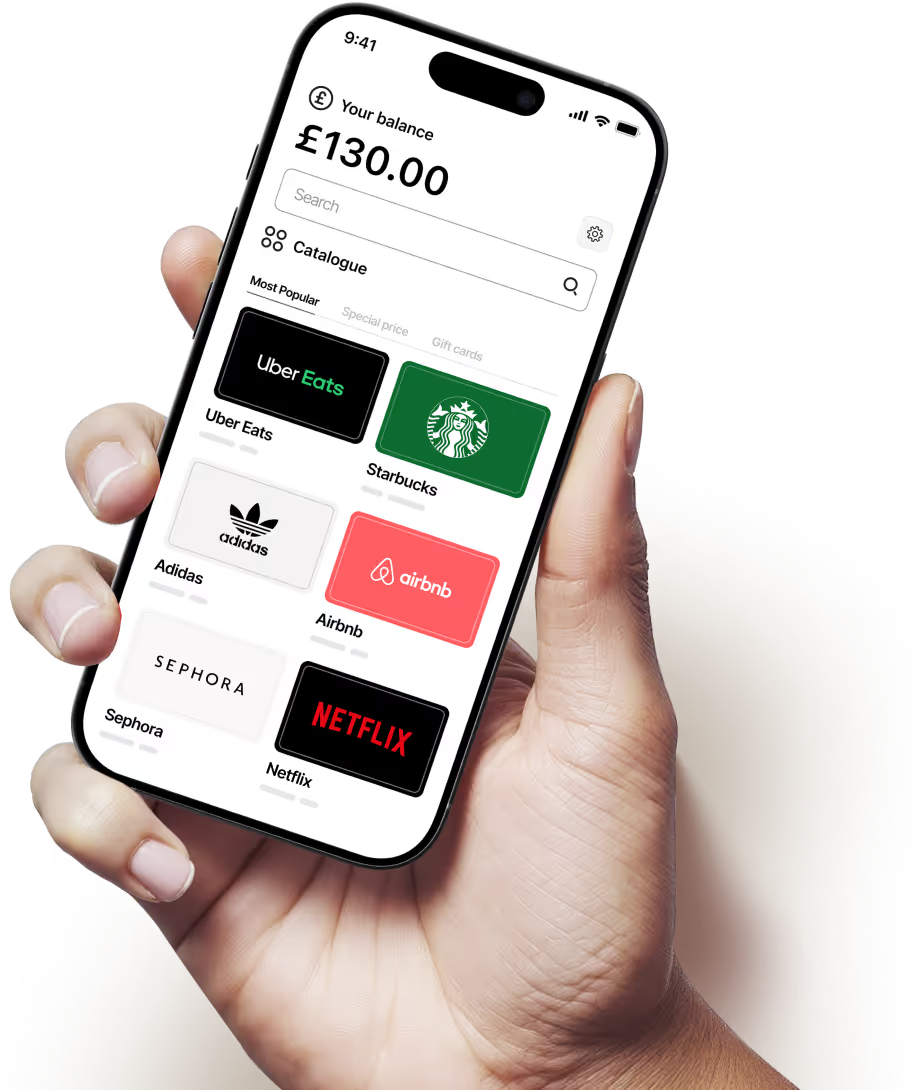
That means access to over 3,000 digital gift card brands alongside prepaid Visa and Mastercard options, all of which can be curated and surfaced based on recipient segment, geography, or preference data. Multi-choice reward experiences let recipients pick from a selection that's been thoughtfully curated for them, combining the agency of choice with the care of curation. And every touchpoint is fully brandable so the experience carries your identity throughout.
Totally's API integrates into existing CRM and marketing systems, enabling automated, event-driven reward delivery that adapts to recipient data without manual campaign management. Real-time tracking provides visibility into campaign performance so you can learn from each programme and apply those learnings to the next.
The aim is to take the operational weight out of personalisation so your team can focus on the strategy, the messaging, and the moments that make a reward feel like it was sent by a company that genuinely cares about the person receiving it.
Personalisation in rewards is evolving from offering choice to shaping the entire experience around what you know about the recipient. The data infrastructure, AI capabilities, and platform technology to do this at scale exist today. The question for most businesses is less about whether to personalise and more about where to start.
Begin with your existing data. Run one test. Measure what happens. Let the results guide what comes next.
The programmes that get this right will create the kind of moments where a reward from their company actually stands out in someone's day.
Want to see what personalised reward campaigns look like at scale? Drop us a note.
.avif)