.png)

Let’s build something great
See how Totally’s API can support your reward and payout workflows. Talk to our team to explore your use case, or access our documentation when you’re ready to get started.
Book a Demo
A practical framework for matching incentive type, value, and delivery to each research methodology, audience, and market you operate in.


Participant recruitment is getting harder. Email survey response rates now average between 3% and 15% depending on audience and context. Panel fatigue is a documented and growing concern across the industry. And the competition for willing, engaged participants intensifies with every new study that enters the field. Research businesses, insights platforms, and panel providers are all drawing from the same pool, and that pool is getting more selective about what it says yes to.
Incentives sit at the centre of this challenge. What you offer participants, how you deliver it, and how the whole experience feels has a direct influence on who agrees to take part, whether they complete the study, and how much thought they put into their responses. The Incentive Research Foundation found that non-cash rewards like digital gift cards consistently outperform cash in both engagement and participant satisfaction. Participants tend to view a gift card as a thank you rather than a transaction, and that distinction shows up in higher programme satisfaction, better follow-through in multi-wave studies, and stronger panel retention over time.
Despite all of this, most research businesses still apply the same incentive approach to every study they run. One reward type, one value, one delivery method, regardless of whether the participant is completing a five-minute survey or committing to a 90-minute interview with a senior executive. That gap between how incentives are managed and how much they actually influence research outcomes is where the biggest opportunity sits.
This piece maps out how to design an incentive strategy that matches the methodology, audience, and geography of each study, and why getting this right improves recruitment speed, data quality, and participant retention simultaneously.
The incentive conversation in research tends to focus on two questions: should we offer one, and how much should it be? Both matter, but they skip over something more fundamental: the incentive experience influences the composition and quality of your sample.
When incentives are generic, delayed, or poorly calibrated to the effort involved, the participants who show up tend to be the ones who'll complete anything for any reward. Professional survey-takers who optimise for speed and volume. They provide responses, but those responses are often less considered, less complete, and less representative than what you'd get from a broader, more engaged sample.
When incentives are well-matched to the study, appropriately valued, and delivered without friction, the participant pool widens. People who wouldn't normally take part in research become willing to engage when the reward feels fair and the experience feels respectful of their time. And participants who feel valued tend to give more thoughtful, complete answers. Research indicates that participants receiving gift cards provide more considered responses than those receiving equivalent cash, which translates into higher data quality and more actionable insights.
For businesses whose core product is research, this connection between incentive experience and data quality has commercial implications. The quality of the insights you deliver to clients is shaped, in part, by how you treat the people providing them.
Applying the same reward to every study regardless of what's being asked of participants is one of the most common and most avoidable mistakes in research operations. Different methodologies require different levels of commitment from participants, and the incentive strategy should reflect that.
Here's how to think about incentives by study type.
Online surveys (5 to 15 minutes). The standard benchmark for a 10-minute online survey sits between $5 and $15, with digital gift cards preferred over cash for ease of delivery and participant flexibility. Speed of delivery matters here more than anywhere else. When someone finishes a short survey, the reward should arrive within seconds. Instant delivery closes the loop between effort and reward, which improves completion rates and makes participants more willing to take part in future studies. Even a few hours of delay breaks that connection and increases panel attrition over time.
In-depth interviews and focus groups (60 to 120 minutes). These need significantly higher incentive values, typically $75 to $150 or more depending on the audience and subject matter. For B2B research where you're recruiting senior professionals, the incentive needs to reflect the value of their expertise and the opportunity cost of their time. A $10 gift card for a 90-minute interview with a finance director communicates the opposite of respect. Choice-based gift cards work well here because the participant selects a reward relevant to them, and the act of choosing creates a more positive experience than receiving a predetermined card for a brand they may not use.
Longitudinal studies and purchase diaries. Multi-wave research requires a different incentive architecture. Small, frequent rewards keep participants engaged between waves and reduce the attrition that typically accelerates with each subsequent phase. A £5 gift card after each weekly diary entry maintains momentum. A larger milestone reward at the halfway point and at completion creates a structural incentive to see the study through. Progressive accumulation, where the reward for each wave increases slightly, works particularly well because dropping out starts to feel like losing something rather than simply stopping.
Online communities and ongoing panels. Panel retention is one of the biggest operational challenges in the research industry. The participants who provide the most value are the ones who stay engaged over months and years, contributing to multiple studies. Incentive strategies for ongoing panels need to balance regular, consistent rewards with periodic bonuses that keep the experience feeling fresh. Tiered recognition, where active panellists unlock higher reward levels over time, creates a loyalty dynamic that acknowledges ongoing commitment rather than treating each study in isolation.
B2B and expert interviews. Recruiting niche professional audiences (medical specialists, IT decision-makers, financial executives) requires premium incentives and frictionless delivery. These participants are time-poor and have many competing demands on their attention. The incentive needs to be high enough to justify the commitment, delivered in a format that feels appropriate for a professional context, and processed without administrative friction on either side. Prepaid Visa or Mastercard gift cards tend to work well for this audience because they offer complete flexibility without feeling like a consumer promotion.
For research businesses managing incentives across dozens of concurrent projects, each with different methodologies, budgets, participant pools, and geographies, the administrative overhead of incentive management adds up quickly.
Research operations teams frequently find that incentive administration, purchasing, distributing, tracking, and reconciling rewards, takes up a disproportionate amount of time relative to its strategic importance. When each project means a new round of gift card procurement, individual email distribution, manual tracking in spreadsheets, and fielding "where is my reward?" queries from participants, the cumulative time cost is significant.
That cost shows up in several places.
Procurement. Buying gift cards project by project means managing multiple suppliers, handling purchase orders, and maintaining stock. For businesses running research across multiple countries, this multiplies as different markets need different brands, currencies, and delivery formats.
Distribution and support. Sending rewards to individual participants after task completion, tracking which have been delivered, handling failed emails, and responding to support queries all consume time that could be spent on the research itself. In high-volume studies, the support burden alone can require dedicated resource.
Financial reconciliation. Matching incentive spend to project budgets, tracking unused rewards, reconciling across currencies and suppliers, and producing accurate reports on incentive costs creates an accounting workload that sits alongside the operational one.
Compliance across jurisdictions. Tax reporting requirements, data protection obligations, and the regulatory treatment of incentives vary by market. For businesses running global research, ensuring each transaction complies with local requirements adds a layer of complexity that grows with every new country.
The research businesses that have solved this tend to have consolidated onto a single platform that handles procurement, distribution, tracking, and compliance across all projects and geographies from one place. When incentive delivery is automated through an API connected to the survey or research platform, the operational cost per incentive drops substantially and the team's time is freed for work that drives research quality.
Research that spans multiple countries and languages adds a specific set of challenges to the incentive strategy. What works in one market often doesn't translate directly to another.
A gift card brand that participants love in the UK may not exist in Germany, the UAE, or Japan. Appropriate incentive values differ across economies, and what counts as fair compensation for 15 minutes of a participant's time in London is different to what's appropriate in São Paulo or Mumbai. The preferred format for receiving a reward, whether that's a local brand gift card, a prepaid card, or mobile money, also varies by country and demographic.
Managing this through separate procurement in each market leads to delays, inconsistencies, and compliance gaps. The businesses handling global incentives well tend to work with a single infrastructure provider that maintains a broad, multi-country catalogue and applies local curation automatically. The infrastructure handles brand availability, local currency, and compliance across jurisdictions. The research team controls what participants see and how the experience is presented within each study.
For niche B2B research that recruits experts across multiple countries within a single study, the ability to deliver locally relevant, appropriately valued rewards from a single platform removes a logistical barrier that regularly slows international fieldwork and adds cost to project delivery.
Totally provides the incentive infrastructure that research businesses need to deliver rewards across projects, methodologies, and geographies without managing each one individually.
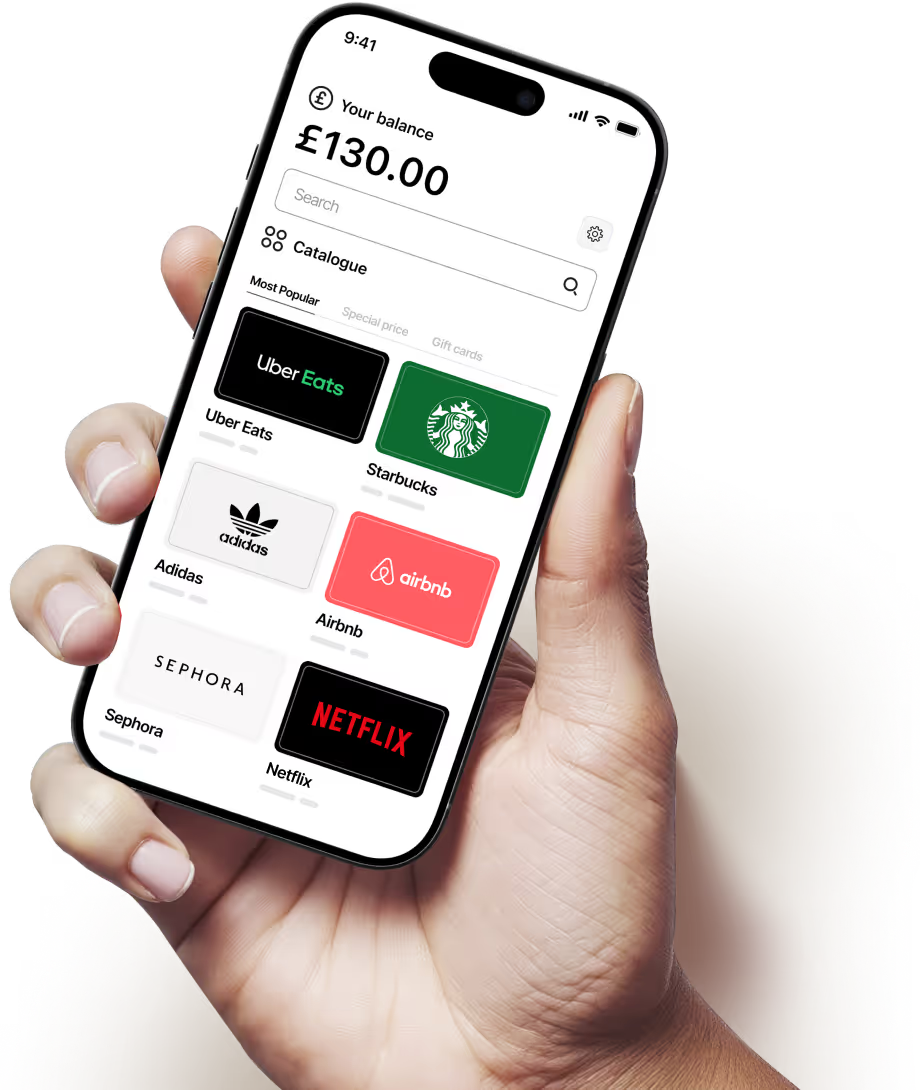
That means API-driven access to over 3,000 digital gift card brands across 50+ countries, prepaid Visa and Mastercard options, and multi-choice reward experiences where participants select the format they prefer. The API integrates into survey platforms, panel management systems, and research workflow tools, enabling automated reward delivery triggered by study completion, qualification, or any custom event the research team defines.
Rewards are delivered instantly. When a participant completes a survey, interview, or diary entry, the incentive arrives within seconds. For research businesses where the speed of reward delivery directly affects completion rates and panel satisfaction, that immediacy makes a measurable difference to fieldwork timelines and participant experience.
Every incentive transaction is tracked and reconciled within the platform, giving operations and finance teams a single view of incentive spend across all active projects. Compliance is handled at the transactional level, accounting for local regulatory requirements in every market Totally operates in.
For research businesses managing incentives across dozens of concurrent projects and multiple countries, Totally removes the procurement, distribution, and compliance overhead so the team can focus on delivering the insights their clients are paying for.
If your research business is managing incentives through manual processes and finding that it takes more time and creates more friction than it should, a few focused steps will clarify where the biggest improvements are.
First, audit how your team currently spends time on incentive administration. Map procurement, distribution, support queries, reconciliation, and reporting across a typical month. The total is usually higher than anyone expects, and it makes the case for consolidating onto a single platform straightforward.
Second, review your incentive strategy by methodology. If every study uses the same reward type and value regardless of participant effort, there's an opportunity to improve recruitment speed and data quality by matching incentives to what each study actually demands.
Third, assess whether your current setup can handle multi-country research efficiently. If adding a new geography means a separate procurement process, a new supplier relationship, and a manual compliance check, the infrastructure isn't keeping pace with how global research operates in 2026.
The research businesses delivering the strongest outcomes treat participant incentives with the same care they apply to questionnaire design, sampling methodology, and analytical rigour. The incentive experience is part of the research experience. When participants feel valued and fairly rewarded, everything that follows, from recruitment speed to data quality to panel retention, works better.
Want to see how Totally can streamline your research incentive programme? Drop us a note!
.avif)