.png)

Let’s build something great
See how Totally’s API can support your reward and payout workflows. Talk to our team to explore your use case, or access our documentation when you’re ready to get started.
Book a Demo
Businesses discount away 18% of their revenue on average. Companies using reward-based promotions instead see 58% higher annual revenue and outperform discount-led approaches by 38%.


Businesses typically discount around 18% of their revenue away. A company operating on 30% gross margins running a 15% discount promotion needs to double its sales volume just to keep profitability flat. Most don't achieve that volume increase. They absorb the margin hit, repeat the promotion next quarter because it's now expected, and gradually train their customer base to buy only when there's a deal on.
This cycle has been running across industries for years, and in 2026 it's intensifying. Acquisition costs are rising. Customers are more willing to switch than ever, with 36% planning to shop around for alternative providers in the next six months across utilities, insurance, banking, and other categories. And brand loyalty has dropped from 77% in 2022 to 69% in 2024, a decline that heavy discounting has accelerated rather than reversed.
The companies growing in competitive markets right now aren't competing on price. They're competing on experience, recognition, and the kind of value that doesn't require cutting into their margins. The data on this approach is substantial: companies using reward-based promotions see a 58% year-on-year increase in annual revenue and outperform discount-based promotions by 38%. Proactive companies that invest in customer engagement show 12 to 23% higher margins than those that default to discounting.
This piece looks at why discounting is a weaker competitive response than most businesses assume, what the alternatives look like in practice, and how reward and incentive programmes create competitive advantage that pricing pressure can't easily replicate.
Discounting works in the short term. That's precisely what makes it dangerous in the long term. The initial promotion drives a volume spike, the sales team reports a good quarter, and the tactic gets repeated. Over time, several things happen simultaneously.
Customers learn to wait. When a brand discounts regularly, buyers adjust their purchasing behaviour accordingly. They delay purchases until the next promotion arrives. The promotion doesn't generate incremental demand. It shifts existing demand into discounted windows, cannibalising full-price revenue.
The competitor matches. A price cut only provides competitive advantage until the competitor responds. In most markets, the response comes within weeks. The result is a lower price floor across the category with no lasting advantage for anyone. Margins compress industry-wide while customer expectations reset to the new normal.
Brand perception shifts. Frequent discounting signals to the market that the full price isn't the real price. In B2B, this weakens negotiating position across the customer base as procurement teams use promotional pricing as a benchmark. In B2C, it trains consumers to perceive the brand through the lens of value rather than quality. Fast Company reported that the assumption that deeper discounting would sustain loyalty was one of the fastest-aging assumptions of 2025, as programmes built primarily on offers trained customers to wait for promotions rather than building genuine loyalty.
Acquisition quality deteriorates. Customers acquired through deep discounts arrive with a transactional expectation. They came for the price, not the product. Their lifetime value is lower, their churn rate is higher, and their likelihood of becoming advocates is minimal. The acquisition looks efficient on a cost-per-customer basis but underperforms on every downstream metric that determines whether the customer was actually worth acquiring.
Exiting becomes painful. Once a customer base is conditioned to expect discounts, removing them feels like a price increase even though it's a return to the original price. The business faces a choice between continuing the margin erosion or enduring a short-term volume drop that the board may not tolerate. Many businesses choose to keep discounting because the exit cost feels too high, which deepens the trap further.
The assumption behind most discounting strategies is that customers are primarily price-driven. The data paints a different picture.
58% of consumers will pay more for a better experience. 75% of B2B buyers say the same. 70% of buyers return to a vendor if they feel appreciated and valued. 80% say they're more likely to buy from a company that personalises their experience. These aren't marginal preferences. They're decisive factors in purchasing and retention decisions that often outweigh price.
The distinction matters for competitive strategy because price is the easiest advantage to replicate. A competitor can match your discount overnight. They can't replicate the experience of receiving a thoughtful, personalised reward that made a customer feel valued. They can't recreate the loyalty programme that's given a customer three months of accumulated progress they'd have to abandon to switch. They can't reproduce the referral relationship where a customer's friend recommended your brand because of how the recognition programme made them feel.
80% of UK consumers now actively engage in at least one loyalty scheme, up significantly over the past 12 months. But participation alone isn't driving loyalty. The programmes that are actually retaining customers are the ones delivering relevance, personalisation, and moments of genuine value rather than generic points and blanket discounts. 87.5% of loyalty programme owners plan to engage with customers in more non-transactional ways, recognising that emotional loyalty, built through recognition and experience, withstands competitive pressure in ways that transactional loyalty never does.
Each of these addresses a specific competitive scenario with a reward-based response that delivers value to the customer without reducing the price of the product.
Acquiring against a cheaper competitor. When a competitor is winning on price, matching them erodes your margins and concedes that price is the battlefield. A different approach: offer a sign-up incentive that delivers tangible value (a £10 to £25 gift card or multi-choice reward) without changing the product price. The customer receives something of genuine value. Your pricing holds. And the cost to you is lower than a discount of equivalent perceived value because gift cards are purchased at wholesale rates, typically 5 to 30% below face value. A £15 gift card that costs you £11 to £13 delivers £15 of perceived value without touching your product price.
Referral programmes compound this further. Reward existing customers for referring new ones with a gift card for both parties. Referral CAC runs between £110 and £160 versus £630+ for paid search. Referred customers retain 25 to 40% better than those from paid channels. The acquisition is cheaper, the customer quality is higher, and the competitor's price advantage becomes less relevant because the new customer arrived through a trusted recommendation rather than a price comparison.
Retaining customers being actively poached. When competitors are targeting your customer base with aggressive offers, the defensive response isn't to match their deal. It's to make the cost of leaving feel higher than the benefit of switching. Loyalty programmes that accumulate value over time (reward credits, tier status, personalised perks that improve with tenure) create switching costs that a competitor's one-off offer can't overcome. A customer who's built six months of tier progress and has £30 of accumulated reward credit isn't switching for a 10% introductory discount. The accumulated value anchors them.
Surprise-and-delight rewards during competitive pressure periods reinforce the relationship at the moment it's most vulnerable. A personalised gift card arriving with a message that acknowledges the customer's loyalty, timed to land when competitors are running acquisition campaigns in your category, creates positive prediction error (the neuroscience principle covered in our piece on the psychology of rewards) at exactly the right moment.
Winning back customers lost to a competitor. A customer who left for a better price often discovers that the competitor's product or experience doesn't match what they had. The win-back window is typically 30 to 90 days. A personalised gift card with a message that references the customer's previous relationship with your brand (not a generic "we miss you" email) creates a low-friction path back. The gift card delivers value immediately without requiring the customer to commit to a purchase first, which lowers the psychological barrier to returning.
Recovering from a service failure before it becomes a reason to switch. In competitive markets, every service failure is an opportunity for a competitor. Customers who experience a problem and receive a swift, proportionate response with a goodwill gesture (a gift card that acknowledges the inconvenience) are often more loyal afterward than customers who never had a problem. The speed matters more than the value. Reaching a dissatisfied customer within hours with a branded, personalised reward communicates more care than a discount code sent three days later by an automated system.
The commercial argument for reward-based competitive responses versus discounting is straightforward once the numbers are laid out.
A 15% discount on a £100 product costs the business exactly £15 in lost revenue. A £15 gift card costs the business £11 to £13 (wholesale pricing) while delivering £15 of perceived value to the customer. The business saves £2 to £4 per transaction while the customer perceives equivalent value.
At scale, this difference compounds. A business running 10,000 promotional transactions per quarter at 15% discount foregoes £150,000 in revenue. The same business delivering £15 gift card rewards across those 10,000 transactions spends £110,000 to £130,000, a saving of £20,000 to £40,000, while delivering equivalent perceived value to the customer.
The downstream economics further tilt the equation. Customers acquired through reward-based promotions show 16 to 25% higher lifetime value than those acquired through discounts. Loyalty programme members generate 12 to 18% more incremental revenue per year. And the brand perception impact is opposite: rewards enhance it while discounts erode it.
For anyone presenting this to a CFO or board, the argument isn't that rewards are nicer than discounts. It's that they're cheaper to deliver, generate higher customer lifetime value, protect pricing integrity, and build competitive moats that price-matching can't replicate.
The most important strategic difference between discounting and reward-based competition is durability.
A price cut provides advantage until the competitor matches it, which usually happens quickly. The advantage is temporary and the cost is permanent (the margin never fully returns).
A reward programme provides advantage that deepens over time. Each month a customer stays, their accumulated value increases and switching becomes less attractive. Each referral brings in a customer who's predisposed to loyalty. Each personalised reward interaction strengthens the brand association. Each data point from the programme improves the next interaction.
This compounding dynamic means the businesses that invest in reward-based competitive strategies early build an advantage that becomes progressively harder for competitors to replicate. A competitor can match your price tomorrow. They can't replicate the loyalty programme a customer has been building with you for 18 months.
The industry is moving in this direction. Investment in discount-led promotions is declining across enterprise brands while investment in experience-based, personalised loyalty is increasing. 60% of enterprise brands plan to strengthen the integration between loyalty and promotions in 2026, using incentives with greater precision rather than defaulting to blanket discounts. The companies that have made this transition are seeing 5 to 7x ROI from their loyalty programmes, performance that discounting has never delivered at any scale.
Totally provides the reward infrastructure for marketing, commercial, and loyalty teams looking to build competitive advantage through personalised, branded reward experiences rather than margin-eroding discounts.
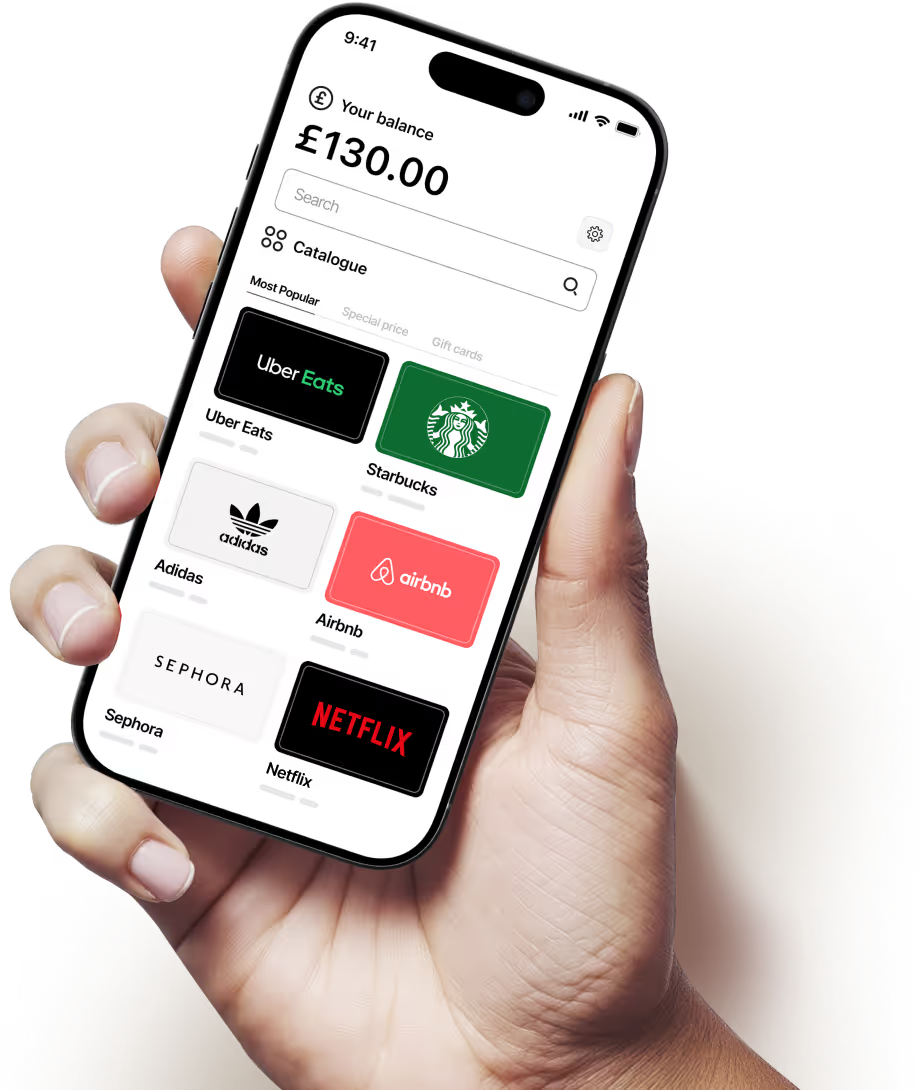
That means API-driven access to over 3,000 digital gift card brands across 50+ countries, prepaid Visa and Mastercard options, and multi-choice reward experiences where customers choose their preferred reward. Every reward touchpoint is fully brandable, so the competitive moment, the moment a customer receives something valuable, reinforces your brand rather than feeling like a generic transaction.
Sign-up incentives, referral programmes, loyalty rewards, surprise-and-delight campaigns, service recovery gestures, and win-back offers can all be triggered automatically through Totally's API, integrated with existing CRM and marketing platforms. Real-time tracking connects reward activity to acquisition, retention, and revenue data, providing the measurement foundation that proves the ROI and justifies continued investment.
For businesses facing pricing pressure and looking for a competitive response that protects margins while building customer loyalty, Totally handles the reward infrastructure so the commercial team can focus on strategy.
If your current competitive response defaults to discounting, and you're seeing the margin compression and customer behaviour patterns described in this piece, a focused test will clarify whether a reward-based approach delivers better results for your business.
Pick one competitive scenario: acquisition against a cheaper competitor, retention during an aggressive competitor campaign, or win-back of recently churned customers. Design a reward-based response for that scenario using gift cards or multi-choice rewards rather than a discount. Run it alongside your existing approach for 90 days and compare: acquisition cost, customer lifetime value at 90 days, retention rate, and margin impact per customer.
The businesses outperforming in competitive markets in 2026 aren't spending more on customer acquisition or giving away more margin. They're investing in the kind of value that customers remember, that competitors can't easily replicate, and that gets more effective the longer it runs.
Want to see how Totally can help you compete without cutting prices? Drop us a note!