.png)

Let’s build something great
See how Totally’s API can support your reward and payout workflows. Talk to our team to explore your use case, or access our documentation when you’re ready to get started.
Book a Demo
Most loyalty programmes are well designed on paper and poorly executed in practice. Automation closes the gap.


Most loyalty programmes are well designed on paper. The strategy document describes personalised rewards triggered at moments that matter, real-time responses to customer behaviour, and a programme that deepens engagement over time. The operational reality looks different: reward batches processed at the end of the month, generic offers sent to broad segments because individual targeting takes too long to manage manually, and a team spending more hours on administration than on programme improvement.
This gap between what a loyalty programme is designed to do and what it actually does day to day is where most retention value gets lost. 73% of consumers say personalisation matters in loyalty programmes, but only 60% think the programmes they're enrolled in actually deliver it. 86% say what counts most is financial value and simplicity. The programmes falling short aren't failing on strategy. They're failing on execution, and the execution gap is almost always operational.
Over 90% of companies globally now run some form of loyalty or rewards programme, and the market is projected to reach $41 billion by 2032. Loyalty programme owners who measure performance report an average ROI of 5.3x. 9 out of 10 report positive returns. The programmes generating those returns aren't running on spreadsheets and manual processes. They've automated the operational layer so that the strategic intent, personalised, timely, behaviour-driven rewards, translates into what the customer actually experiences.
This piece covers which parts of a loyalty programme benefit most from automation, how trigger-based reward delivery changes the customer experience, and what the data generated by automated workflows enables that manual operations can't.
Every loyalty programme involves a set of recurring operational tasks: tracking customer activity, calculating rewards, segmenting audiences, triggering communications, delivering incentives, reconciling spend, and reporting on performance. When these are handled manually, each one introduces delay, error risk, and capacity constraints that dilute the programme's impact.
Delayed reward delivery. When rewards are processed in batches, whether weekly or monthly, the connection between the customer's action and the incentive is broken. A customer who hits a spending milestone on the 3rd of the month and receives their reward on the 28th doesn't associate the reward with the behaviour that earned it. The motivational impact that drives repeat behaviour is largely lost. Sub-one-hour response times achieve 71% retention versus 48% for 24-hour responses. The same principle applies to reward delivery: the faster the loop closes, the stronger the behavioural reinforcement.
Generic segmentation. Manual segmentation takes time, which means most teams default to broad segments (all gold tier members, all customers who joined in the last quarter) rather than the granular, behaviour-based targeting their strategy calls for. The result is a programme that feels generic to the customer despite being designed for personalisation. 80% of consumers say the experience a company provides is as important as its products. A loyalty programme that sends the same offer to every member regardless of their behaviour, preferences, or lifecycle stage isn't delivering on that expectation.
Support ticket volume. Manual processes generate support queries. "Where is my reward?" "Why haven't my points updated?" "I didn't receive my tier upgrade notification." Each of these represents a moment where the customer's trust in the programme erodes. When delivery, tracking, and communication are automated, these queries largely disappear because the system handles them in real time.
Reporting lag. When programme data lives across spreadsheets and disconnected systems, building a performance report takes days rather than minutes. By the time the insights are available, the moment to act on them has often passed. A promotion that underperformed last week can't be adjusted if the team doesn't see the data until next week.
Team capacity. The most direct cost of manual operations is the team's time. Every hour spent reconciling points, processing reward batches, or pulling segment lists is an hour not spent on programme strategy, campaign design, or the kind of creative work that differentiates a good loyalty programme from a forgettable one. Loyalty teams that automate their operational workflows report spending 60 to 70% less time on administration.
Automation in loyalty programmes works best when it handles the operational mechanics and frees the team for the strategic and creative work that requires human judgment.
Automate: reward triggers and delivery. When a customer hits a spending threshold, completes a purchase streak, refers a friend, or reaches an anniversary milestone, the reward should be issued automatically and delivered instantly. No manual calculation, no batch processing, no delay between the action and the incentive. This is the single highest-impact automation in most loyalty programmes because it directly affects how the customer experiences the reward.
Automate: tier management. Customers should be upgraded (or downgraded) the moment they cross a threshold, with immediate notification and access to their new benefits. Manual tier processing creates a window where the customer has earned their status but can't access it, which undermines the programme's credibility.
Automate: lifecycle communications. Welcome sequences for new members, milestone acknowledgements, expiry reminders for unused points, re-engagement flows for lapsing members, and referral prompts for promoters can all be triggered by customer behaviour rather than managed as manual campaigns. These touchpoints become consistent, timely, and scalable.
Automate: data capture, reconciliation, and reporting. Every transaction, every reward issuance, every redemption, and every customer interaction should flow into a unified data layer automatically. Point balances should update in real time across all channels. Financial reconciliation should happen within the platform rather than in a separate spreadsheet. And performance dashboards should be live, not compiled manually at the end of each month.
Automate: fraud detection. Duplicate submissions, suspicious activity patterns, and manipulated documentation can be flagged automatically before rewards are processed. Manual review of every transaction isn't scalable, and automated detection catches patterns that human review would miss at volume.
Keep human: programme strategy and design. Which behaviours to reward, what the tier structure should look like, how the programme evolves over time, and how it connects to the broader brand experience are all decisions that require judgment, creativity, and an understanding of the customer that goes beyond data. Automation executes the strategy. Humans define it.
Keep human: high-value relationship moments. A VIP customer reaching a significant milestone or a long-standing member going through a service recovery situation benefits from a personal touch that automation can't replicate. The system can flag these moments. The team decides how to respond.
Keep human: creative campaign design. Seasonal campaigns, partnership promotions, surprise-and-delight initiatives, and programme refreshes all benefit from creative thinking that automated workflows can support but shouldn't replace.
The most significant operational shift automation enables is the move from batch-processed, periodic rewards to event-driven, real-time rewards.
In a manual programme, rewards are typically processed on a schedule. Points are calculated at the end of the week. Tier upgrades happen at the end of the month. Re-engagement campaigns are built manually when someone notices participation is declining. The customer experiences the programme as something that runs on the company's timeline rather than responding to their actions.
In an automated, trigger-based programme, the customer's behaviour is the trigger. Each action generates an immediate, appropriate response.
A customer reaches a spending milestone. Within seconds, they receive a notification congratulating them and their reward is available to redeem. A member's purchase frequency drops below their usual pattern. A personalised re-engagement offer is triggered automatically, tailored to their category preferences, before they've consciously decided to disengage. A customer refers a friend who makes their first purchase. Both the referrer and the new customer receive instant rewards, reinforcing the behaviour while the positive feeling is still fresh. A member's points are approaching expiry. A reminder is sent with a curated selection of redemption options based on their previous choices, creating urgency without pressure.
Each of these interactions happens without manual intervention. The rules are defined once. The system executes them consistently, at scale, in real time.
The customer experience difference is substantial. The programme feels responsive and attentive rather than administrative and periodic. 53% of consumers say they'll share personal information if it makes interactions smoother. When that data is used to trigger timely, relevant rewards, the programme delivers on the implicit promise that sharing data will result in a better experience.
When every interaction in a loyalty programme is automated and tracked, the data generated creates a compounding advantage that manual programmes can't replicate.
Manual programmes produce data, but it's fragmented, delayed, and often incomplete. Points are tracked in one system. Redemptions in another. Customer communications in a third. Building a unified view of how the programme is performing and how individual customers are engaging requires manual consolidation that takes time and introduces errors.
Automated programmes generate a continuous, unified data stream. Every trigger fired, every reward delivered, every redemption made, every communication sent and opened, every tier transition. All of it flows into a single data layer in real time.
That data enables a cycle of continuous improvement that gets faster with each iteration.
Understanding what drives retention. Which reward types generate the highest redemption rates across different segments? Which triggers are most effective at preventing lapse? Which tier benefits create the strongest lock-in? In an automated programme, these questions have real-time answers rather than requiring a quarterly analysis project.
Personalising at scale. Customer preferences emerge from their behaviour patterns. Someone who consistently redeems dining rewards should see dining options surfaced first. Someone who engages heavily during seasonal promotions should receive early access to the next one. Automation makes this level of personalisation operationally feasible across thousands or millions of members.
Identifying programme weaknesses. If redemption rates drop in a specific segment, or if a particular reward type underperforms, the data surfaces it immediately rather than weeks later. The team can adjust the programme while the issue is contained rather than discovering it in a retrospective.
Connecting loyalty data to broader business metrics. When programme data flows into the CRM and analytics infrastructure, it can be correlated with customer lifetime value, purchase frequency, basket size, referral behaviour, and revenue attribution. Loyalty becomes a measurable contributor to business outcomes rather than an activity tracked in isolation. Loyalty programme members generate 12 to 18% more revenue than non-members, and premium tier members show 2.7x higher lifetime values. Connecting those outcomes to specific programme mechanics, which rewards drove tier progression, which triggers prevented churn, is where the data flywheel creates strategic value.
Automation discussions tend to focus on operational efficiency, but the customer-facing impact is equally important and often more compelling when making the internal case for investment.
Customers don't experience your operational workflows. They experience the programme. When that experience is responsive, personalised, and consistent, engagement increases. When it's slow, generic, or unreliable, they disengage regardless of how good the underlying strategy is.
Three specific customer experience improvements come directly from operational automation.
Consistency across channels. When a customer earns points in-store, those points should be visible in the app immediately. When they redeem online, the balance should update in real time for their next in-store visit. Over three quarters of consumers use brand apps more frequently when offered personalised incentives and loyalty rewards. That engagement depends on the app reflecting accurate, current programme data, which requires real-time synchronisation across all touchpoints.
Reduced friction in redemption. The moment a customer decides to redeem a reward should be frictionless. If they have to wait for points to process, navigate a confusing redemption flow, or contact support because their balance doesn't reflect a recent transaction, the positive moment the programme was designed to create becomes a frustrating one instead. Automated systems ensure balances are current, redemption options are available instantly, and the experience from selecting a reward to receiving it takes seconds rather than days.
Timely, relevant communication. Automated lifecycle messaging ensures that every member receives the right message at the right time based on their actual behaviour, not based on when someone on the team gets around to building the campaign. Welcome sequences start immediately. Milestone celebrations arrive on the day. Expiry reminders land with enough time to act. Each of these touchpoints reinforces the feeling that the programme is paying attention, which is what drives the emotional loyalty that keeps customers enrolled and engaged.
Totally provides the reward delivery infrastructure that loyalty teams need to automate their programme's operational layer without building custom reward fulfilment systems.
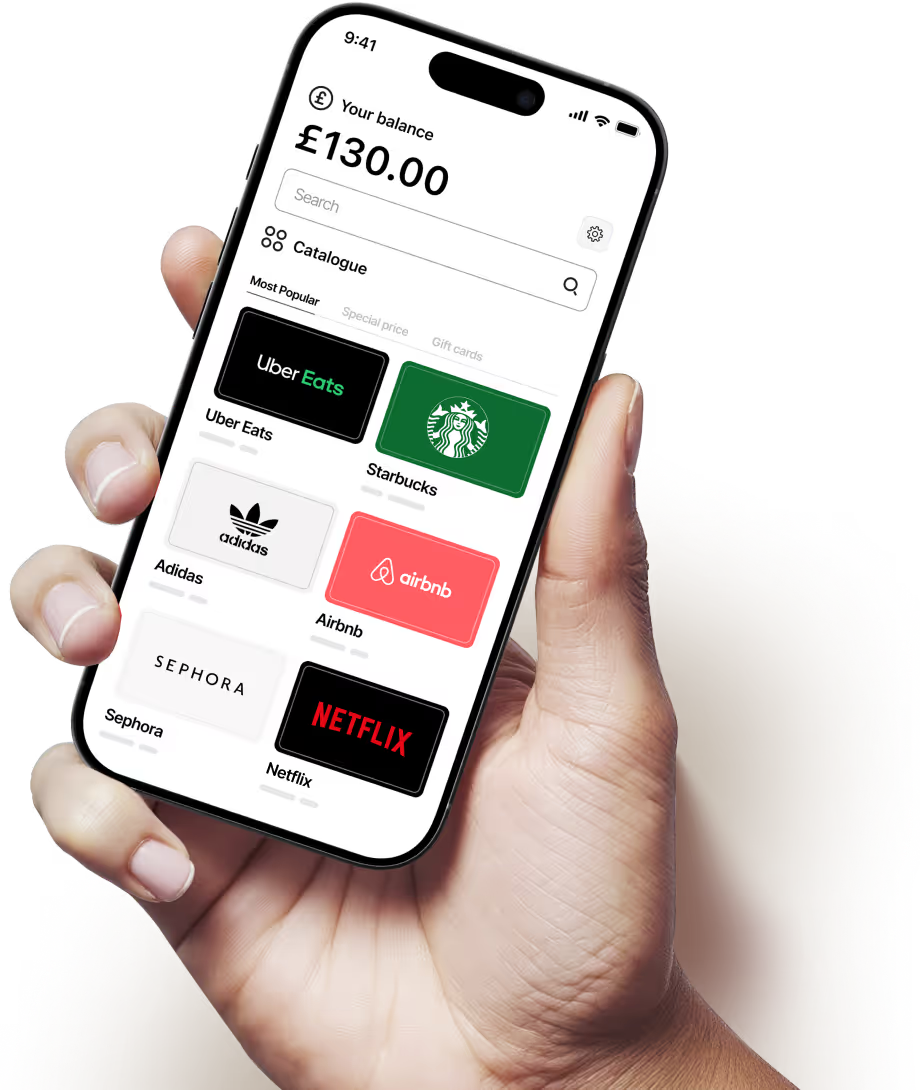
That means API-driven integration into existing CRM, marketing automation, and loyalty platforms, enabling automated reward delivery triggered by any customer event: spending milestones, tier transitions, referral conversions, re-engagement triggers, or custom lifecycle moments. Rewards are delivered instantly from a catalogue of over 3,000 digital gift card brands across 50+ countries, alongside prepaid Visa and Mastercard options and multi-choice reward experiences where members select what they want.
Every reward interaction is tracked in real time, giving loyalty teams the data they need to understand which rewards drive engagement, which triggers prevent churn, and how programme spend connects to retention outcomes. The delivery experience is fully brandable, so the reward feels like a native part of the loyalty programme rather than a handoff to a separate platform.
For loyalty teams that have built the strategy but need the operational infrastructure to execute it at scale, Totally handles the reward delivery, tracking, and compliance so the team can focus on making the programme better rather than keeping it running.
If your loyalty programme's strategy describes personalised, timely, behaviour-driven rewards but the operational reality involves batch processing, broad segmentation, and manual reconciliation, the gap between the two is where your biggest retention gains are likely sitting.
Map which of your current operational tasks could be trigger-based rather than schedule-based. Reward delivery, tier management, lifecycle communications, and re-engagement flows are usually the highest-impact starting points. Each one directly affects what the customer experiences.
Then look at your data infrastructure. If programme data lives across disconnected systems and reporting requires manual consolidation, the data flywheel described in this piece can't function. Centralising programme data into a unified layer, ideally through API integration with your existing platforms, is the foundation that makes everything else work.
The loyalty programmes reporting 5.3x average ROI and generating 12 to 18% more revenue from members aren't running fundamentally different strategies from everyone else. They're executing those strategies with operational infrastructure that translates intent into experience consistently, at scale, in real time.
Want to see how Totally can automate your loyalty programme's reward delivery? Drop us a note.