

Let’s build something great
See how Totally’s API can support your reward and payout workflows. Talk to our team to explore your use case, or access our documentation when you’re ready to get started.
Book a Demo
Where to buy, which card type to choose, how to handle tax across markets, and how to track and optimise over time.


Gift cards account for 43% of all corporate incentives in North America according to the Incentive Research Foundation, making them the most widely used non-cash reward format. 59% of North American organisations expect their total rewards and recognition budgets to increase this year. And the global gift card market reached $1.24 trillion in 2025, projected to hit $3.81 trillion by 2034.
For businesses buying gift cards in batches of 50, 500, or 5,000, the format has proven itself. The practical questions are where to buy, which card types to use, how to handle tax and compliance, and how to manage delivery and tracking across markets. Those decisions determine whether the programme runs smoothly or creates admin overhead that nobody budgeted for.
This guide walks through each decision with the context you need to make it well.
Businesses buying digital gift cards in bulk have three main purchasing channels. Each involves a different trade-off between simplicity, flexibility, and operational control.
Purchasing gift cards directly from a single retailer (Amazon Business, Walmart Business, or a specific brand's corporate programme) is the simplest entry point. You contact the retailer, place a bulk order, and receive cards for that brand only.
This works when you know exactly which brand every recipient wants and your programme operates in one market. It stops working the moment you need to offer choice, cover multiple countries, or manage more than one brand.
The limitations compound at scale. Each retailer is a separate procurement process, a separate invoice, and a separate delivery mechanism. Branding options are limited to what the retailer offers. Tracking and redemption data comes from each retailer individually, if at all. And international coverage depends entirely on whether that retailer operates in your recipients' markets.
Gift card distributors aggregate cards from multiple brands and sell them to businesses in bulk. This gives you access to a wider range of brands through a single supplier, which simplifies procurement compared to buying direct from multiple retailers.
Distributors handle the supplier relationships and can offer volume-based pricing on larger orders. The trade-off is that distribution is typically their core service, not the recipient experience. Branding, personalisation, delivery tracking, and redemption analytics may be limited or handled through separate systems.
A digital reward platform like Totally combines the catalogue breadth of a distributor with the delivery, branding, tracking, and compliance infrastructure that direct retail and distribution channels lack.
The platform handles everything from catalogue management and recipient uploads through to branded delivery, real-time tracking, redemption analytics, and financial reconciliation. Multi-choice reward experiences where recipients select their own brand are built into the delivery mechanism. API integration enables automated, event-triggered delivery connected to existing HR, CRM, or marketing platforms.
For programmes running across multiple countries, the platform surfaces locally relevant brands by geography, denominates in local currency, and manages jurisdiction-level compliance automatically.
Three card formats are available for bulk programmes, each suited to a different use case.
Spendable anywhere that accepts card payments, online and in-store. Maximum flexibility for the recipient. No brand restriction.
Open-loop cards carry activation fees (typically $4 to $7 per card in the US), which should be factored into programme budgets. In the UK, prepaid Visa and Mastercard cards do not qualify for the HMRC trivial benefits exemption because they are treated as cash equivalents.
Best for: programmes where maximum recipient flexibility is the priority, or where the recipient base is too diverse to predict brand preferences. Research incentives, customer rebates, and international programmes where local brand availability is uncertain.
Tied to a specific retailer. The recipient can only spend at that brand. Available from most major retailers in digital format.
No activation fees in most cases. Qualifies for the UK trivial benefits exemption at £50 or under. The trade-off is that you're betting the recipient shops at that retailer. If they don't, the card goes unused or gets regifted.
Best for: programmes where you know the recipient's preferences well, or where a specific brand carries strategic significance (a coffee chain card for a daily thank-you, a dining card for a team celebration).
The recipient receives one gift card and chooses which brand to redeem it for from a curated catalogue. Spans retail, dining, entertainment, gaming, streaming, experiences, wellness, and more.
No activation fees. Qualifies for the UK trivial benefits exemption because the recipient selects from retailer-specific brands rather than receiving a cash equivalent. Combines the flexibility of an open-loop card with the personalisation and engagement of a curated gift experience.
Multi-choice is the fastest-growing format in corporate gifting. IRF research found that personalisation through choice drives the strongest impact on satisfaction and recall. The act of choosing creates ownership over the reward.
Best for: most programmes. Employee recognition, holiday gifting, marketing incentives, loyalty rewards, and any programme where you want high redemption without guessing individual preferences.
Six steps cover the practical process from planning through to ongoing optimisation.
Get clear on the programme purpose before placing an order. Employee recognition, customer acquisition, research incentives, loyalty, channel partner rewards, and seasonal gifting all have different dynamics around denomination, frequency, and recipient expectations.
The IRF reports that $50 and $100 cards account for 51% of all corporate gift card distributions, with the average denomination across programmes at $142. For employee recognition specifically, $25 is the minimum that feels meaningful. Below that, the gesture risks feeling token.
Map your planned send moments (birthdays, anniversaries, campaign milestones, holiday gifting) against your headcount or recipient list to establish the total budget. Get finance approval before procurement begins, and confirm the tax treatment with your finance team for each market you're sending to.
For a one-off batch of single-brand cards, buying direct from the retailer may be sufficient. For anything recurring, multi-brand, international, or involving more than a few hundred recipients, a digital reward platform will save significant time and provide the tracking, branding, and compliance infrastructure that direct purchasing lacks.
Evaluate platforms on catalogue breadth, international coverage, delivery options, branding capabilities, API integration, tracking and analytics, and compliance management. The comparison table earlier in this guide covers these dimensions.
Open-loop, closed-loop, or multi-choice. The decision guide above maps each format to specific use cases. For most programmes, multi-choice delivers the best combination of flexibility, personalisation, and compliance eligibility.
If your programme spans the UK and the US, card format has compliance implications. Prepaid Visa and Mastercard cards don't qualify for UK trivial benefits. Multi-choice cards selecting from retailer-specific brands do. Your platform should handle this distinction automatically based on recipient location.
For a batch send, upload a CSV with recipient names and email addresses. That's all you need for digital delivery. No home addresses, no phone numbers, no dietary requirements.
Write the message. Gallup's research identifies personalisation as one of the five pillars of strategic recognition. A genuine, specific note from the right person (a manager, a CEO, not "the HR department") transforms the gift card from a transaction into a recognition moment. Personalised messaging works at scale through digital platforms without requiring individual manual sends.
Set up your company branding so every delivery carries your visual identity.
Three delivery modes suit different programme types.
Immediate send for one-off batch deliveries. Upload, personalise, send. Every recipient receives their gift card within seconds.
Scheduled send for planned moments. Set the delivery date and time in advance. The programme executes automatically. Holiday gifting, company-wide celebrations, and campaign launches all benefit from scheduled delivery so every recipient receives theirs simultaneously.
Automated send via API for ongoing programmes. Connect the platform to your HRIS, CRM, or marketing automation system. Define triggers (work anniversary, survey completion, referral conversion, milestone reached) and the platform delivers the gift card automatically when the event fires. No manual intervention per delivery.
Monitor redemption data through the platform dashboard. Which brands are recipients choosing? How quickly are they redeeming? What's the overall redemption rate? Which denominations drive the highest engagement?
This data is what separates a one-off gifting exercise from an optimised programme. If 60% of recipients choose dining brands, strengthen the dining coverage in your catalogue next quarter. If redemption is slow at a particular denomination, test a higher amount. If one delivery mode outperforms another, shift the balance.
The IRF's 2026 Industry Outlook shows dining gift cards (54%) overtaking online-only retailers (50%) as the most-used branded type among North American programme owners. Tracking your own programme data tells you whether your specific recipients follow that trend or diverge from it.
International programmes add a layer of complexity that the right platform handles automatically.
Catalogue localisation. A gift card to a UK retailer has no value for a recipient in Germany or Japan. The platform should surface locally relevant brands in each recipient's market without the buyer needing to research brand availability country by country.
Currency denomination. Recipients should see the gift value in their own currency. A £50 gift should feel like £50 of value everywhere, without conversion confusion or visible FX fees.
Compliance by territory. Tax treatment, expiry rules, data protection requirements, and fee restrictions all vary by jurisdiction. The platform should apply jurisdiction-level compliance automatically rather than requiring the buyer to research rules in each country.
Instant delivery everywhere. Digital delivery eliminates the shipping, customs, and courier challenges that make physical international gifting operationally heavy. Every recipient receives their gift card via email at the same speed regardless of location.
Totally supports digital gift card delivery across 50+ countries with locally relevant catalogues, local currency denomination, and jurisdiction-level compliance managed within the platform.
Totally provides the infrastructure for businesses that want to buy and distribute digital gift cards in bulk without the operational overhead of managing multiple suppliers, tracking deliveries manually, or researching compliance in every market.
3,000+ digital gift card brands across 50+ countries. Retail, dining, entertainment, gaming, streaming, experiences, wellness, and prepaid Visa and Mastercard. Locally relevant catalogues surface automatically by recipient location.
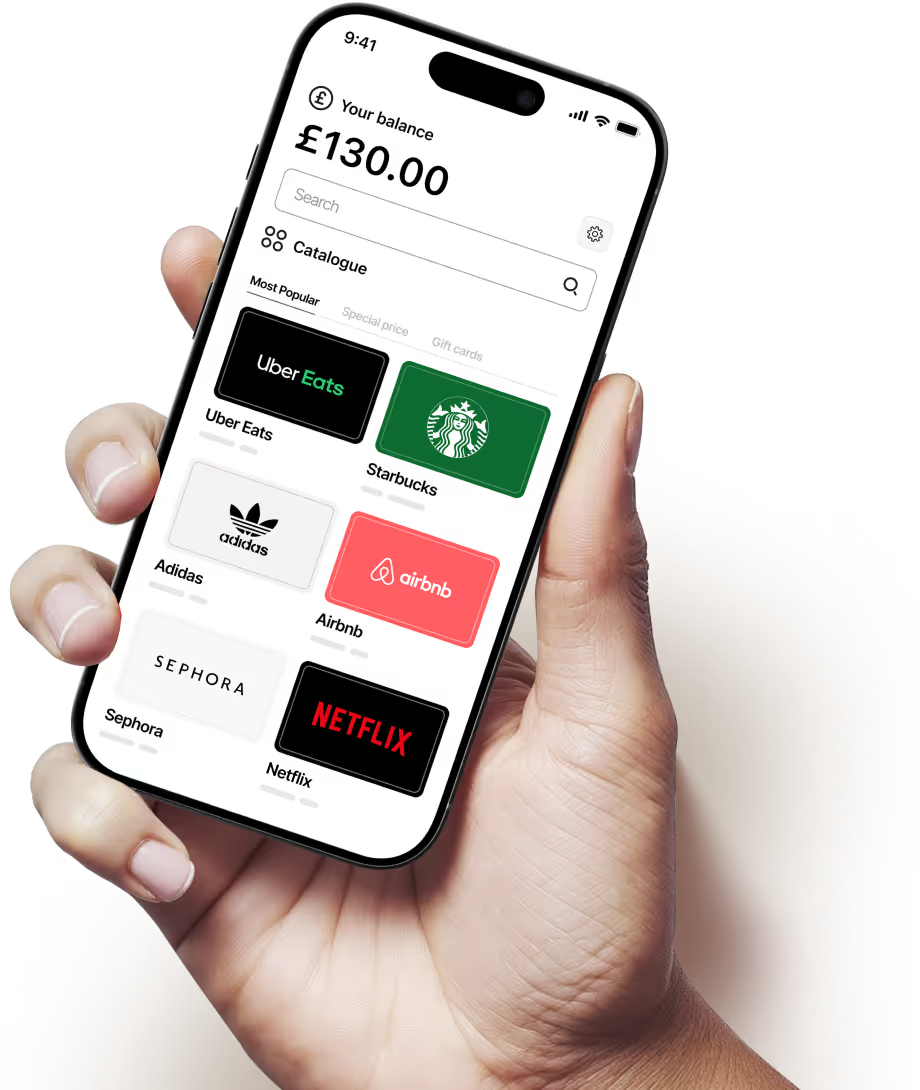
Multi-choice reward experiences. Recipients browse a curated catalogue and choose. The company controls the budget and quality. The recipient controls the outcome.
Full branding and personalisation. Your company's identity on every touchpoint. Personalised messages at scale.
Three delivery modes. Immediate batch send via CSV upload. Scheduled delivery for planned moments. Automated API-driven delivery for ongoing programmes.
Real-time tracking and analytics. Delivery status, redemption rates, brand preferences, and spend. One dashboard across all markets.
Compliance managed by territory. ISO 27001 certified. GDPR and CCPA compliant. Jurisdiction-level tax treatment applied automatically.
No hidden costs. Transparent pricing at face value. No shipping, packaging, or logistics surcharges for digital delivery.
Ready to set up your bulk digital gift card programme? Book a complimentary consultation.
What is the easiest way to buy digital gift cards in bulk?
Through a digital reward platform like Totally, which lets you upload a recipient list, select from 3,000+ brands, personalise each delivery, and send instantly via email. For ongoing programmes, API integration automates delivery based on events in your existing systems.
Can you buy digital gift cards in bulk internationally?
With Totally, digital gift cards can be delivered to recipients in 50+ countries. The catalogue surfaces locally relevant brands automatically, rewards are denominated in local currency, and compliance is managed at the platform level across all markets.
How much do bulk digital gift cards cost?
Most platforms, including Totally, price at face value with no platform fees for digital delivery. Open-loop prepaid cards (Visa/Mastercard) typically carry an activation fee of $4 to $7 per card. Volume-based pricing is available for larger programmes.
Which card type is best for bulk employee rewards?
Multi-choice digital gift cards consistently drive the highest redemption rates and satisfaction because recipients select their preferred brand from a curated catalogue. They also qualify for the UK trivial benefits exemption at £50 or under, unlike prepaid Visa and Mastercard cards.
Are bulk gift cards taxable?
In the US, all gift cards given to employees are taxable compensation regardless of value. In the UK, retailer-specific gift cards up to £50 per occasion qualify for the HMRC trivial benefits exemption (tax-free, no P11D reporting). Rules vary by jurisdiction. Totally manages tax compliance at the platform level.
How do I track bulk gift card redemption?
Totally provides a real-time dashboard showing delivery status, redemption rates, which brands recipients chose, and how programme spend tracks against budget. This data feeds directly into programme optimisation.
What's the difference between open-loop and closed-loop gift cards?
Open-loop cards (Visa/Mastercard) are spendable anywhere that accepts card payments. Closed-loop cards are tied to a specific retailer. Multi-choice cards let the recipient choose from a catalogue of retailer-specific brands, combining flexibility with personalisation.