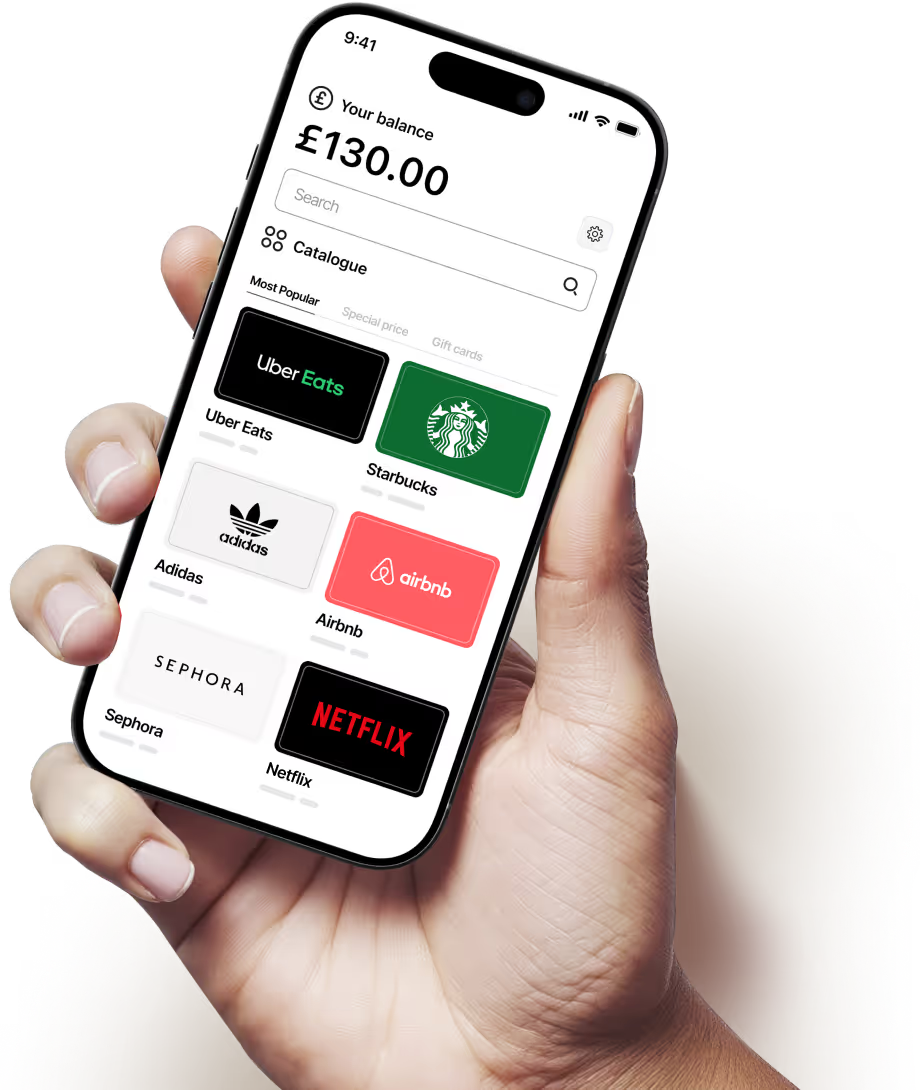


Let’s build something great
See how Totally’s API can support your reward and payout workflows. Talk to our team to explore your use case, or access our documentation when you’re ready to get started.
Book a Demo
How fintechs and neobanks are building reward mechanics directly into their products to drive activation, transaction frequency, and referral loops.


The global neobank market is projected to reach $394.6 billion by 2026. Expected neobank users globally will hit 350 million by the same year. And the fintechs growing fastest aren't just acquiring users efficiently. They're building reward mechanics directly into their products that drive transaction frequency, deepen engagement, and create revenue streams that compound as usage grows.
Embedded rewards are incentives, cashback, and digital gift cards woven directly into the fintech product experience. They fire at the moments that influence user behaviour: onboarding completion, first transaction, spending milestones, referrals, and tier upgrades. 75% of consumers say they favour companies that offer rewards. Banks with loyalty programmes see 18% higher deposit growth than those without. And referred customers deliver 25 to 37% higher lifetime value than users acquired through other channels.
The neobanks and fintechs embedding rewards into their product are seeing the results across every metric that matters: higher activation rates, increased transaction frequency, stronger referral loops, and the kind of habitual usage that turns a downloaded app into a primary financial relationship.
36% of neobank customers have adopted premium subscription tiers specifically because of cashback and reward benefits. Bain & Company research shows that a 5% improvement in retention alone can increase profitability by up to 95%. When rewards are embedded into the product rather than bolted on as a separate programme, they influence both acquisition and retention simultaneously.
This guide covers how embedded rewards work within fintech products, the six use cases driving adoption, the build-versus-partner decision, and how Totally's API provides the infrastructure layer that makes it work.
Embedded rewards in a fintech context means the incentive fires inside the product workflow, not alongside it. The user isn't redirected to an external rewards portal. They aren't sent a separate email with a voucher code. The reward appears natively within the app they're already using, at the moment the qualifying behaviour occurs.
A user completes KYC and a gift card notification appears in their app within seconds. A customer hits a savings milestone and a cashback reward credits to their account. A referral converts and both parties see the reward in their dashboard instantly. Each of these moments reinforces the connection between the behaviour and the platform, which is what builds the habitual usage patterns that drive retention.
This is structurally different from traditional loyalty programmes where points accumulate in a separate system, redemption requires navigating to a different interface, and the connection between the user's daily financial activity and the reward is weak enough that most people forget about it.
Bond Brand Loyalty research found that 72% of consumers say loyalty programmes make them more likely to spend with a brand. The key qualifier: that only holds when the programme is frictionless and present in the moment of decision. A rewards tab the user visits once a quarter doesn't drive the same behaviour as a reward that appears at the point of action.
The drop-off between sign-up and KYC completion is one of the most expensive leaks in the fintech funnel. Users download the app, begin the process, and abandon it before submitting documents. A digital gift card that triggers automatically at the moment a user completes KYC creates a tangible incentive to finish the process and an immediate positive association with the platform.
The reward needs to arrive within seconds. Any delay between the qualifying action and the reward delivery weakens the behavioural link. API-driven delivery handles this automatically, firing the reward the moment the backend confirms document submission.
The first 30 to 90 days determine whether a new user becomes an active customer or joins the 27% who go inactive within a year. Rewarding the first transaction, first direct deposit, or first card payment creates a positive reinforcement loop during the window that matters most.
Structured milestone rewards during this period (first transaction, fifth transaction, first month of activity) build the early usage habits that correlate with long-term retention. Each reward gives the user a reason to come back and use the platform again, which is what separates the accounts that stick from the ones that sit dormant.
Cashback on everyday spending is the most established embedded reward model in fintech. 75% of consumers say they favour companies that offer rewards. 36% of neobank customers have adopted subscription-based premium tiers specifically because they offer cashback benefits.
The evolution in 2026 is from flat-rate cashback (which is margin-negative at scale) to multi-choice reward experiences where users can direct their earned value toward gift cards from brands they actually want. This shifts cashback from a cost centre to an engagement tool: the user actively chooses how to use their reward rather than passively accumulating fractions of a percent.
Behaviour change requires reinforcement at the right moments. Rewarding a user when they hit a savings target, complete a budgeting challenge, or maintain a balance threshold for a defined period creates a positive association between financial discipline and the platform.
These milestone rewards serve a dual purpose: they drive the financial behaviour the platform is designed to encourage, and they create the kind of memorable moments that generate word-of-mouth and social sharing. A user who receives a gift card for hitting their first £1,000 in savings remembers both the achievement and the platform that acknowledged it.
Referred customers deliver 25 to 37% higher lifetime value and churn 18 to 25% less than users acquired through other channels. For fintechs facing rising acquisition costs, referral programmes with embedded reward delivery are among the most cost-efficient growth channels available.
The critical design element: the reward should fire inside the app for both the referrer and the referee at the moment of conversion, not days later via a separate email. Instant, in-app delivery creates the viral loop that scales: the referrer sees the reward immediately, which motivates the next referral. A reward that arrives three days later by email has already lost the moment.
Banks with loyalty programmes see 18% higher deposit growth than those without. Tiered loyalty structures, where benefits increase with usage or account level, create a progression mechanic that motivates ongoing engagement rather than one-off activity.
Embedded rewards within these tiers (higher cashback rates, access to premium gift card catalogues, exclusive brand partnerships) differentiate the tiers with tangible value rather than cosmetic badges. The upgrade from a free tier to a paid tier becomes easier to justify when the rewards at the higher tier have demonstrable, immediate value.
The first instinct for most fintech product teams is to build rewards in-house. The platform has the engineering capacity, the user data, and the product infrastructure. Adding a rewards layer feels like a feature sprint rather than an infrastructure project.
In practice, rewards infrastructure is a supply chain, not a feature. Building in-house means owning gift card vendor relationships across multiple markets, multi-currency settlement logic, fraud detection, recipient delivery experiences, catalogue management, and compliance requirements that vary by jurisdiction.
Custom builds carry a 66% rate of cost overruns and take significantly longer than planned. For most fintech and neobank product teams, rewards are infrastructure rather than the core product. The engineering hours spent building and maintaining a rewards supply chain are hours not spent on the financial product features that actually differentiate the platform.
The cases where building in-house makes sense are narrow: platforms where the reward catalogue itself is a core product differentiator, or volumes high enough to justify owning the full supply chain economics. For most teams, partnering via API delivers a faster launch, broader catalogue, and lower ongoing operational overhead.
A rewards API connects your fintech product to the reward catalogue and fulfilment infrastructure. Your product team controls the front-end experience. The API handles everything behind it.
Catalogue access. A single integration provides access to digital gift cards, prepaid cards, and multi-choice reward options across brands, categories, countries, and currencies. No individual brand negotiations. No separate supplier contracts per market.
Event-triggered delivery. Define triggers within your product: KYC completion, first transaction, savings milestone, referral conversion, tier upgrade. The API delivers the appropriate reward automatically when the event fires. The reward reaches the user within seconds.
Backend control. The API returns reward data to your backend without automatically emailing the user. Your product team controls when and how the reward appears in the app. This is essential for embedded experiences where the fintech platform owns the front-end user journey.
Multi-market coverage. For fintechs operating across countries, the API handles local brand availability, local currency denomination, and jurisdiction-level compliance automatically. Expanding into a new market is a configuration change rather than a new supplier integration.
Lifecycle tracking. Order status, delivery status, and redemption status are all queryable via the API in real time. Your product team can surface reward status within the app and feed engagement data into retention analytics.
For a detailed overview of compliance considerations across markets when distributing digital gift cards internationally, see our compliance guide.
Totally provides the rewards infrastructure layer that fintech and neobank product teams need to embed incentives into their platform without building or managing the reward supply chain.
3,000+ digital gift card brands across 50+ countries. Retail, dining, entertainment, gaming, streaming, experiences, wellness, and prepaid Visa and Mastercard. The catalogue surfaces locally relevant brands automatically based on the end user's location and currency.
Single integration, global coverage. One API connection provides access to the full catalogue across all supported markets. No need for separate supplier relationships or country-by-country procurement.
You control the experience. The API returns reward data to your backend. Your product team decides how the reward appears within your app. Build a native in-app reward experience that matches your product's design system and user flow. No auto-emails. No external redirects.
Event-triggered automation. Define triggers based on any event in your product. KYC completion, first transaction, referral conversion, savings milestone, tier upgrade. The API handles fulfilment automatically when the event fires.
Multi-currency and multi-market. Rewards denominated in the user's local currency with locally relevant brands. Compliance managed at the jurisdiction level across all supported markets. ISO 27001 certified, GDPR and CCPA compliant.
Real-time tracking. Full lifecycle visibility from order through to redemption. Feed this data back into your product analytics to optimise which rewards, denominations, and triggers drive the strongest retention outcomes.
Sandbox and documentation. A full sandbox environment for your engineering team to test against, with publicly available API documentation. Most fintech teams move from API access to live programme within four to eight weeks.
For fintech and neobank product teams evaluating embedded rewards, three steps will clarify whether the model fits and how to move forward.
Map your highest-churn moments. Identify where users drop off: KYC abandonment, post-sign-up inactivity, first-month disengagement, the period after a sign-up bonus expires. These are the moments where an embedded reward has the highest impact on retention. Start with one or two triggers rather than building a comprehensive programme from day one.
Run the build-versus-partner analysis. Estimate the engineering hours, supplier negotiations, compliance research, and ongoing maintenance required to build rewards in-house. Compare that against a four-to-eight-week API integration. For most teams, the math favours the API.
Test with a single use case. Connect to the API, implement one trigger (KYC completion or first transaction are the most common starting points), and measure the impact on completion rates and 30-day retention. The data from one use case provides the evidence needed to expand the programme.
The fintechs and neobanks building the strongest retention are treating rewards as product infrastructure, embedded into the workflows that shape user behaviour, firing at the moments that matter, and creating the kind of habitual engagement that keeps users active beyond the first month. A rewards API gets you from zero to live in weeks. What you build with the behavioural loops and retention data afterward is the actual product work.
Want to explore how embedded rewards would work in your fintech product? Talk to Totally or start with our API documentation.
What are embedded rewards in fintech?
Embedded rewards are incentives (digital gift cards, cashback, prepaid cards) integrated directly into a fintech app's user experience. The reward triggers and delivers natively within the product, without redirecting users to external sites or separate loyalty portals.
How do embedded rewards improve fintech retention?
By firing rewards at the moments that most influence whether a user stays or churns: KYC completion, first transaction, savings milestones, referral conversions, and loyalty tier upgrades. Bain & Company estimates that a 5% retention improvement can increase profitability by up to 95%.
How long does it take to integrate a rewards API into a fintech product?
Most fintech product teams move from API access to a live programme within four to eight weeks. Custom in-house builds typically take 6 to 18 months and cost $100K to $500K+, with a 66% rate of cost overruns.
Should fintechs build rewards in-house or use an API partner?
For most teams, partnering via API delivers faster time-to-market (weeks versus months), broader catalogue (3,000+ brands versus what you negotiate individually), and lower ongoing overhead. Building in-house makes sense only when the reward catalogue itself is a core product differentiator.
What reward formats work best for neobanks?
Multi-choice digital gift cards (where users select their preferred brand from a curated catalogue) outperform single-brand cards and flat cashback on engagement metrics because the user has agency over the outcome. 64% of consumers aged 18-44 prefer rewards that work across multiple brands.
Can a rewards API support multi-country fintech products?
Yes. Totally's API provides access to 3,000+ brands across 50+ countries through a single integration. The catalogue surfaces locally relevant brands and denominates in local currency automatically based on the end user's location.
What compliance considerations apply to embedded rewards in fintech?
Tax treatment, data protection (GDPR, CCPA), and local gift card regulations vary by jurisdiction. For a detailed breakdown by market, see our compliance guide. Totally manages jurisdiction-level compliance within the platform, ISO 27001 certified.