

Let’s build something great
See how Totally’s API can support your reward and payout workflows. Talk to our team to explore your use case, or access our documentation when you’re ready to get started.
Book a Demo
Gift card regulations vary by country, card type, and recipient relationship. A practical guide covering UK trivial benefits, US tax treatment, EU directives,


Gift card regulations vary by country, by state, and in some cases by the type of card being sent. Expiry rules, tax treatment, fee restrictions, data protection requirements, and reporting obligations all differ depending on where the recipient sits and what kind of gift card they receive.
For a business sending digital gift cards to 50 employees in one country, this is manageable. For a business running a reward programme across the UK, US, EU, Canada, and the Middle East, or a platform operator embedding gift cards into their product for end users in multiple jurisdictions, the compliance landscape becomes a genuine operational challenge.
The good news: if you choose the right partner platform to handle the delivery, compliance and jurisdiction-level rules are managed automatically.
This guide covers the key compliance considerations across major markets, the tax treatment rules that HR and finance teams need to understand, what platform operators should know about stored-value and payment services regulations, and how Totally manages compliance across 50+ countries so your team doesn't have to.
Rules governing gift card expiry, fees, and consumer protections vary significantly across jurisdictions. The table below summarises the key requirements across the markets where Totally operates most actively.
For UK-based businesses, the HMRC trivial benefits exemption is the most relevant compliance consideration for employee gift cards. It allows employers to give employees gifts worth up to £50 per occasion completely free of tax and National Insurance, with no P11D reporting required, provided four conditions are met.
The four conditions:
The gift costs £50 or less including VAT. This is a cliff edge, not a threshold. A gift worth £50.01 is fully taxable, not just the amount over £50.
The gift is not cash or a cash voucher. Retailer-specific digital gift cards (Amazon, M&S, John Lewis) and multi-retailer digital gift cards qualify. Prepaid Visa and Mastercard cards do not, because they can function as cash equivalents.
The gift is not a reward for work or performance. A Christmas gift given to the whole team qualifies. A gift card given specifically because someone hit a sales target does not, regardless of value.
The gift is not part of a contractual entitlement. If employees expect to receive the gift as part of their employment terms, it loses trivial benefit status.
Practical implications for programme design:
The £50 limit applies per occasion, not per year. An employer can give multiple trivial benefits throughout the year as long as each individual gift stays within £50. A £40 birthday gift in March, a £30 thank-you in July, and a £50 Christmas gift in December all qualify independently.
Directors of close companies (most owner-managed UK businesses) face an annual cap of £300 across all trivial benefits per tax year. Any amount over £300 becomes taxable.
Record-keeping is recommended even when gifts qualify for the exemption. Documenting what was given, to whom, the value, and the occasion protects the business in the event of an HMRC enquiry.
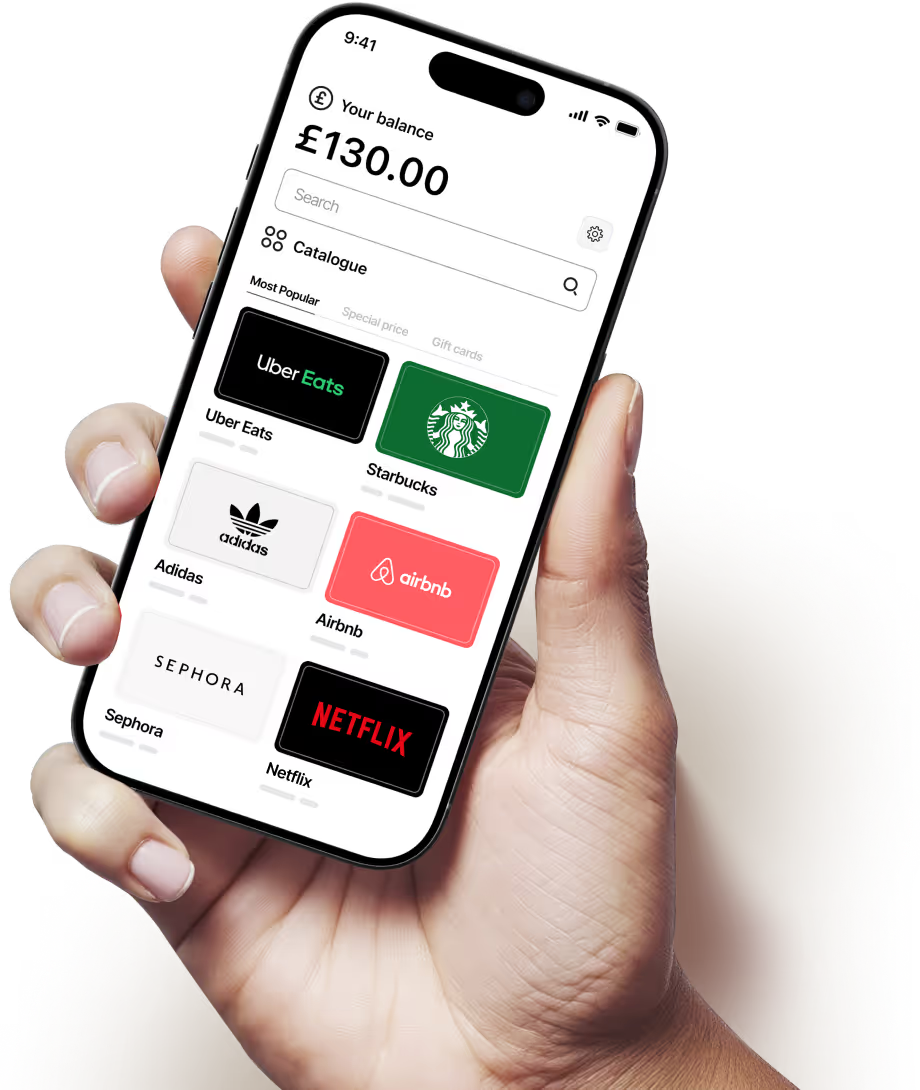
For multi-choice digital gift cards, the format itself supports compliance. The employee chooses from a catalogue of retailer-specific brands, which means the gift card is never a cash equivalent and meets the second condition automatically. This is one of the reasons multi-retailer digital gift cards have become the preferred format for UK employee gifting: they satisfy the trivial benefits rules by design.
Unlike the UK, the United States offers no tax exemption for employee gift cards regardless of value. The IRS treats all gift cards given by employers as taxable compensation. A $10 coffee card and a $500 department store card are both subject to income tax and employment tax.
This means US employers must report gift card values on employees' W-2 forms. For non-employees (customers, research participants, partners), amounts may fall under 1099-MISC reporting if the total value given to one person in a calendar year reaches $600 or more.
For businesses running programmes across both the UK and the US, this creates a compliance divergence that the platform needs to handle at the transaction level. A £50 gift card sent to a UK employee is tax-free under trivial benefits. The same value sent to a US employee is taxable compensation. The rules are jurisdiction-specific, and the system processing the delivery needs to know the difference.
For businesses embedding digital gift cards into their products, apps, or platforms rather than sending them as standalone rewards, an additional layer of regulation applies.
Payment Services Directive (PSD2/PSD3) in the EU and UK. Digital gift cards that function as stored-value instruments fall under payment services regulation. Most gift cards qualify for the Limited Network Exemption, which keeps them off e-money registers and avoids the full weight of payment services compliance. Whether a specific gift card product qualifies depends on its acceptance network, functionality, and whether it can be used for general purchases or only within a defined merchant network.
Anti-Money Laundering (AML) requirements. Gift cards above certain value thresholds can trigger AML obligations including customer due diligence checks. These thresholds vary by jurisdiction. Platforms handling high-volume, high-value gift card transactions need robust AML screening integrated into the delivery workflow.
Data protection. Processing recipient personal data (names, email addresses, redemption behaviour, location data) triggers obligations under GDPR in Europe, CCPA in California, and equivalent legislation in other jurisdictions. The platform must handle data collection, storage, processing, and deletion in compliance with each applicable framework.
Delivery verification. In a tightening regulatory environment, flagging an email as "sent" is no longer sufficient to demonstrate delivery for audit purposes. Platforms should implement delivery confirmation, opening verification, and active balance validation to maintain audit transparency.
Totally is built to handle jurisdiction-level compliance automatically, so the businesses using the platform don't need to become experts in gift card regulation across every market they operate in.
ISO 27001 certified. Totally's information security management meets the international standard for protecting sensitive data. This covers the systems, processes, and controls that handle recipient personal information, transaction data, and financial reconciliation.
GDPR compliant. All data processing involving EU and UK recipients meets GDPR requirements including lawful basis for processing, data minimisation, storage limitation, and the right to erasure.
CCPA compliant. For US recipients, Totally meets the California Consumer Privacy Act requirements including transparency about data collection, the right to opt out of data sale, and the right to deletion.
Jurisdiction-level tax treatment. Totally's platform applies the appropriate tax rules based on the recipient's location. A gift card sent to a UK employee is processed with trivial benefits eligibility in mind. A gift card sent to a US employee is flagged as taxable compensation. The compliance logic is built into the delivery layer rather than requiring the HR team to research rules in each country.
Real-time tracking and reporting. Every gift card delivery is tracked with full audit trail: send time, delivery confirmation, redemption status, brand selected, and value. This data supports compliance reporting, financial reconciliation, and escheatment tracking where applicable.
Multi-retailer digital gift cards by default. Totally's multi-choice format uses retailer-specific gift cards rather than cash-equivalent prepaid cards, which means the gift card format itself supports compliance with rules like the UK trivial benefits exemption. For programmes where prepaid Visa or Mastercard is specifically needed, those options are available with the appropriate tax treatment applied automatically.
Automated reconciliation. Programme spend, redemption data, and tax-relevant transaction records are consolidated in one dashboard across all markets. No manual spreadsheet reconciliation across multiple jurisdictions.
If you're setting up a digital gift card programme and want to ensure compliance from the start, four steps will cover the most important ground.
Confirm the tax treatment in every market you're sending to. In the UK, gifts under £50 are tax-free under trivial benefits. In the US, all gift cards are taxable. In the EU, rules vary by member state. Your platform should handle this at the transaction level, but your finance team should understand the rules in each market.
Choose the right card format for your compliance requirements. Multi-retailer digital gift cards qualify for the UK trivial benefits exemption. Prepaid Visa and Mastercard cards do not. If your programme spans both the UK and the US, you may need different card formats for different markets, or a platform that manages this automatically.
Ensure your data processing meets privacy requirements. Collecting recipient names, email addresses, and redemption data triggers GDPR, CCPA, and equivalent obligations. Your platform should handle data protection compliance as part of the delivery infrastructure.
Keep records. Even when gifts are tax-exempt, maintaining records of what was sent, to whom, the value, and the occasion protects the business. A platform with real-time tracking and audit trail capabilities handles this automatically.
Want to ensure your gift card programme is compliant across every market? Book a consultation.
Are gift cards to employees taxable in the UK?
Not always. Retailer-specific gift cards up to £50 per occasion can be completely tax-free under HMRC's trivial benefits rule, provided the gift isn't cash or a cash voucher, isn't a reward for performance, and isn't contractual. Prepaid Visa and Mastercard cards do not qualify as they are treated as cash equivalents.
Are gift cards to employees taxable in the US?
Yes, always. The IRS treats all gift cards given to employees as taxable compensation regardless of value. There is no de minimis exemption. Gift card values must be reported on W-2 forms.
What is the UK trivial benefits exemption?
An HMRC rule allowing employers to give employees tax-free gifts worth £50 or less per occasion, with no P11D reporting required, provided the gift isn't cash, isn't performance-related, and isn't contractual. Multiple trivial benefits can be given throughout the year. Directors of close companies face a £300 annual cap.
Do gift cards expire?
Expiry rules vary by jurisdiction. In the US, the CARD Act requires a minimum 5-year validity. In Canada, major markets prohibit expiry entirely. In the UK, there's no statutory minimum but major retailers follow a 2-year voluntary code. In the EU, rules vary by member state.
How does Totally handle compliance across different countries?
Totally applies jurisdiction-level compliance rules automatically at the point of delivery. Tax treatment, data protection, and regulatory requirements are managed within the platform across all 50+ supported markets. The platform is ISO 27001 certified, GDPR compliant, and CCPA compliant.
Do digital gift cards qualify for the UK trivial benefits exemption?
Yes, provided they are retailer-specific or multi-retailer digital gift cards (not prepaid Visa or Mastercard) and meet the four HMRC conditions: £50 or less, not cash, not performance-related, not contractual. Multi-choice digital gift cards where the employee selects from a catalogue of retailer brands qualify by design.
What compliance certifications does Totally hold?
Totally is ISO 27001 certified for information security management, GDPR compliant for EU and UK data protection, and CCPA compliant for US data privacy requirements. Real-time tracking provides full audit trails for compliance reporting across all markets.