.png)

Let’s build something great
See how Totally’s API can support your reward and payout workflows. Talk to our team to explore your use case, or access our documentation when you’re ready to get started.
Book a Demo
Each NPS segment represents a different relationship dynamic, and each responds to a different type of reward intervention. This piece maps specific strategies to promoters, passives, and detractors, focused on improving the behaviours that drive NPS rather than incentivising the survey itself.


Two-thirds of Fortune 1000 companies now use Net Promoter Score as a core metric for customer health. The appeal is obvious: a single number that segments your customer base into promoters, passives, and detractors, each with distinct commercial implications. Promoters spend 20 to 30% more over their lifetime than average customers. 50% of detractors churn within 90 days of the survey. And NPS explains 20 to 60% of the variation in organic growth rates between competitors within the same industry.
Most businesses track NPS. Fewer act on it in a structured way. And fewer still connect their reward and loyalty programmes to the specific behaviours that move customers between segments. That connection is where the commercial value sits, because each NPS segment represents a different relationship dynamic, and each responds to a different type of intervention.
This piece maps out how to use rewards strategically across the promoter, passive, and detractor segments to influence the behaviours that drive NPS improvement over time. One important distinction upfront: this is about using rewards to improve the customer experience and the behaviours that naturally lift NPS. It is not about incentivising the survey itself. Rewarding people for completing an NPS survey or offering perks in exchange for higher scores skews the data and defeats the purpose of measuring genuine sentiment. The strategies here focus on creating experiences that make customers more likely to recommend you because they genuinely want to, not because they were compensated to say so.
Before getting into the specific reward strategies, for commercial context, NPS segments map directly to revenue behaviour.
Bain & Company's research on affluent banking customers found that promoters give their primary bank nearly 45% more of their household deposit balances than detractors. They buy 25% more products from the bank. Their attrition rate averages one-third that of detractors. And they make nearly seven times as many positive referrals. When the Bain team modelled the lifetime value difference, a single promoter was worth roughly $9,500 more than a single detractor. Detractors actually had negative lifetime value, meaning they destroyed shareholder value through service costs, negative word-of-mouth, and high churn.
These numbers are from banking, but the underlying dynamics apply across industries. Promoters cost less to serve, buy more, stay longer, and bring in new customers. Detractors cost more, buy less, leave sooner, and actively discourage others from buying. Passives sit in between, vulnerable to competitors and one experience away from tipping in either direction.
The implication for reward programme design is that moving even a small percentage of customers from one segment to another has measurable revenue impact. Converting 5% of your passives into promoters, or preventing 5% of your detractors from churning, changes the economics of your customer base in ways that compound over time.
Promoters are your most commercially valuable customers, but many businesses make the mistake of assuming they'll advocate for the brand on their own. Some will. Most need a reason, a prompt, and a mechanism.
The opportunity with promoters is to channel their positive sentiment into specific, measurable behaviours: referrals, reviews, testimonials, social sharing, and case study participation. These are the actions that turn passive goodwill into active growth.
Referral rewards tied to outcomes. A referral programme with a well-chosen gift card reward for both the referrer and the new customer creates a structured loop where your happiest customers become your most cost-effective acquisition channel. The economics are usually compelling: if your standard CAC through paid channels runs £40 to £60, and a referral programme with a £10 to £15 gift card reward acquires customers at an effective cost of £15 to £25, the margin improvement is significant. And referred customers retain 25 to 40% better than those acquired through paid channels, which further improves the lifetime value equation.
Recognition that feels personal, not transactional. Promoters respond well to rewards that acknowledge their loyalty in a way that feels considered rather than automated. A milestone reward at the one-year anniversary of their relationship with your brand, or a gift card tied to a specific behaviour (their 50th purchase, their 10th referral), creates a moment that reinforces the emotional connection. The reward value doesn't need to be large. What matters is that it arrives at a moment that feels meaningful and is presented in a way that shows the brand noticed.
Exclusive access and early involvement. Promoters are often your most engaged product users. Inviting them into beta programmes, early access groups, or feedback panels (with appropriate incentives for their time) deepens their investment in the brand while generating valuable product insight. This creates a virtuous cycle where the promoter feels valued, provides useful feedback, and becomes even more invested in the product's success.
Passives are the most overlooked segment in most NPS strategies. They score 7 or 8, which means they're satisfied enough to stay for now but not enthusiastic enough to advocate. They're also the segment most vulnerable to competitors, because they lack the emotional attachment that keeps promoters loyal through a bad experience or a price increase.
The opportunity with passives is to create experiences that shift them from rational satisfaction into genuine enthusiasm. Rewards can play a specific role here.
Surprise value at unexpected moments. Passives expect a functional relationship with your brand. They get what they paid for and that's enough. A reward delivered at an unexpected moment, not tied to a purchase or a renewal, can disrupt that neutrality. A gift card arriving with a note that says "thanks for being with us, here's something on us" shifts the relationship from transactional to personal. The surprise element is what creates the emotional response that passive customers are otherwise missing.
Progressive engagement incentives. Passives often underuse the product or service they're paying for. Rewards tied to deeper engagement (completing their profile, trying a feature they haven't used, attending a webinar, providing feedback) create a reason to explore more of what you offer. The more of the product a passive customer uses, the more value they perceive, and the harder it becomes to justify switching.
Personalised recommendations with rewards attached. Using purchase or usage data to recommend something specific to a passive customer, and pairing that recommendation with a small incentive to try it, combines personalisation with a tangible nudge. If your data shows that customers who adopt a particular feature or product category tend to become promoters, attaching a reward to that specific adoption moment accelerates the journey.
Detractors are the most expensive segment in your customer base. They churn at higher rates, cost more to serve, and generate negative word-of-mouth that affects acquisition. 50% churn within 90 days of giving a detractor score, which means the window for intervention is short.
The instinct with detractors is often to offer a discount or a credit to prevent cancellation. That can work in the immediate term, but it trains the customer to expect compensation for dissatisfaction, which is a pattern that erodes margin over time. A more effective approach is service recovery that addresses the root cause of dissatisfaction and uses a reward as a gesture of goodwill alongside the fix, not as a substitute for it.
Speed matters more than value. Research on service recovery consistently shows that the speed of response is more influential than the size of the compensation. Reaching out to a detractor within 24 to 48 hours of their NPS response, acknowledging the issue, and providing a concrete resolution alongside a gift card as a goodwill gesture, demonstrates that the feedback was heard and acted on. The gift card isn't the recovery. The resolution is. The gift card signals that the brand takes the relationship seriously enough to go beyond just fixing the problem.
Match the gesture to the issue. A £5 coffee voucher won't recover someone who experienced a genuine service failure. The reward value and type should be proportionate to what the customer went through. For significant issues, a higher-value prepaid card or a multi-choice reward that lets the customer pick something they actually want communicates more care than a token gesture.
Follow up after recovery. The intervention doesn't end with the apology and the reward. Following up 30 days later to confirm the issue has been fully resolved, and that the customer's experience has improved, completes the recovery arc. Some businesses find that detractors who go through a well-executed recovery process become more loyal than customers who never had a problem, because the recovery demonstrated a level of care they hadn't expected.
The commercial case for NPS-linked reward programmes depends on tracking the right metrics and connecting reward activity to revenue outcomes.
Segment migration. Track how customers move between NPS segments over time. What percentage of passives became promoters in the last quarter? What percentage of detractors were recovered versus churned? These migration rates are the leading indicators that tell you whether your reward interventions are working before the revenue impact fully materialises.
Referral revenue from promoters. Tag customers acquired through promoter referral programmes and track their lifetime value against customers from other channels. This gives you the actual revenue contribution of your promoter reward programme, not just the referral count.
Detractor recovery rate and subsequent behaviour. Of the detractors who received a service recovery intervention with a reward, what percentage were retained? What did their spending behaviour look like over the following 90 days compared to detractors who weren't reached? This tells you whether the recovery programme is generating a positive return.
Reward cost as a percentage of retained revenue. Calculate the total cost of your reward programme against the revenue retained from customers who would otherwise have churned. For most businesses, this ratio is heavily favourable. A £10 gift card that helps retain a customer with a £500 annual value is a 50:1 return.
NPS trend alongside revenue trend. Track your NPS score over time and overlay it with revenue growth, retention rate, and customer lifetime value. The correlation won't be perfect in any single quarter, but over 12 months, businesses that consistently improve NPS tend to see corresponding improvements in these revenue metrics.
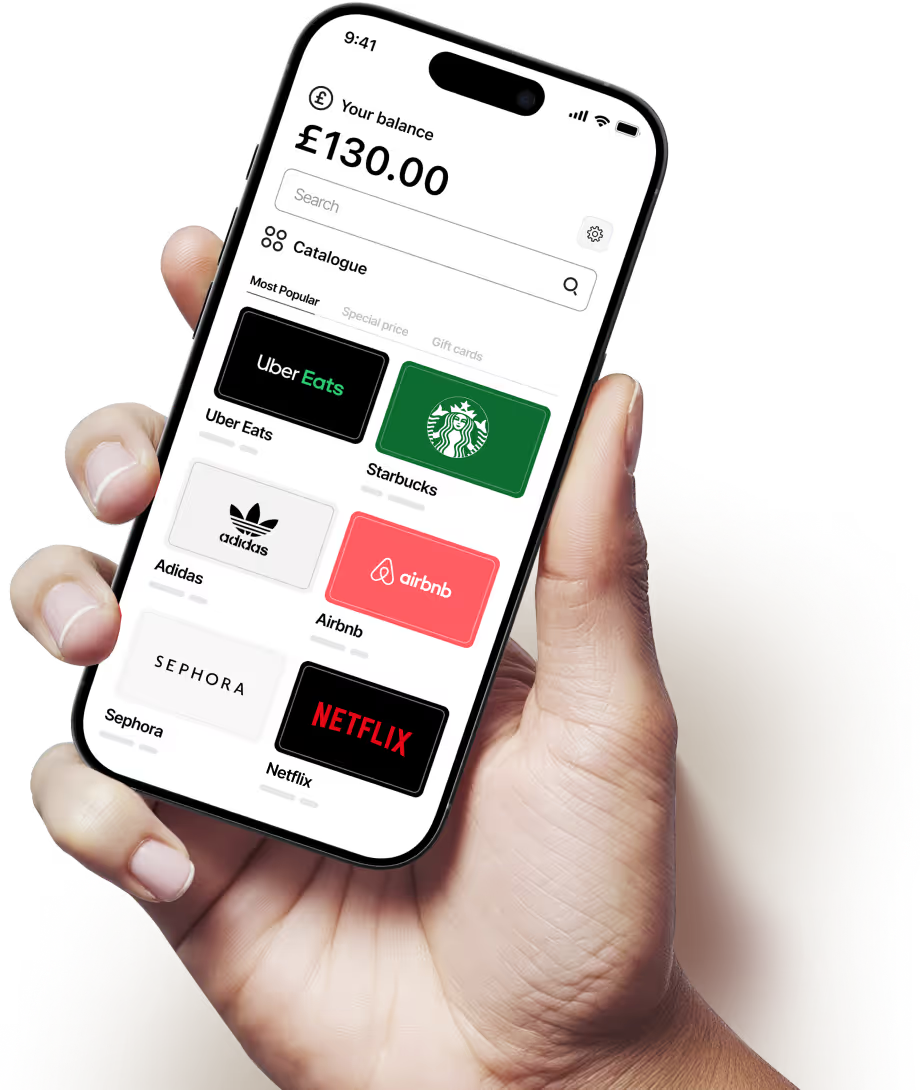
Totally provides the reward infrastructure that makes segment-specific, behaviour-driven reward programmes practical to run at scale.
That means access to over 3,000 digital gift card brands across 50+ countries, prepaid Visa and Mastercard options, and multi-choice rewards where customers select the reward that's most relevant to them. Every touchpoint is fully brandable, so the reward feels like an extension of your customer relationship rather than a generic third-party interaction.
Totally's API integrates into existing CRM systems, customer success platforms, and marketing automation tools, enabling rewards to be triggered automatically by the events that matter: a promoter completing a referral, a passive hitting an engagement milestone, or a detractor going through service recovery. Rewards are delivered instantly, which matters when the timing of the gesture directly affects its impact.
Real-time tracking gives loyalty and CX teams visibility into which rewards are driving segment migration, where spend is going, and how programme costs relate to retention and revenue outcomes. That data feeds back into programme optimisation, creating the improvement loop that makes each quarter's programme more effective than the last.
If your business tracks NPS but hasn't yet connected it to a structured reward strategy, a few focused steps will get you moving.
First, look at your segment distribution and identify where the biggest opportunity sits. If you have a large passive segment, the potential for promoter conversion may be more valuable than detractor recovery. If detractor churn is your primary revenue leak, that's where the first intervention should go.
Second, design one programme for one segment. A referral reward for promoters, a surprise-and-delight campaign for passives, or a service recovery protocol with a gift card component for detractors. Run it for 90 days against a control group and measure segment migration, retention, and revenue impact.
Third, connect the reward data to your NPS data. Track whether customers who received rewards show different NPS trajectories than those who didn't. That connection is what turns a reward programme from a cost line into a revenue strategy with measurable returns.
Want to see how Totally can power NPS-driven reward programmes for your business? Drop us a note!
.avif)